Research

Papers, findings, and scientific contributions from the MSense Lab — spanning time perception, attention, and Bayesian cognition.

Curious Minds
Eye movement: innovation in visual perception training
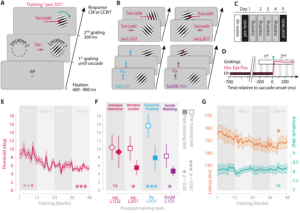
News from the original LMU Newsroom: Constant training improves the capacities of human perception. Just as years of practice hone the senses of smell and…
Curious Minds
Feng Meng, can the ability to see a flea as large as a wheel be transferred?
Feng Meng, can the ability to see a flea as large as a wheel be transferred? Our team member Dr. Lukasz Grzeczkowski has recently revealed in…
Research
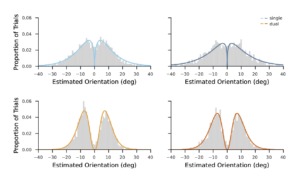
Reference induced biases in late visual processing
Ever notice how our perception can shift when a reference is introduced? Consider the Ebbinghaus illusion—depending on the surrounding disks, a central disk can appear…
Research
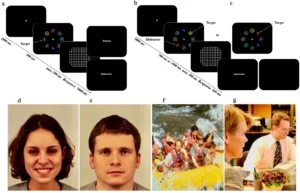
Valence color preference and association
Research has found that emotion-associated features, such as color, can influence our attention. However, what has been neglected is individuals may have their own color-valence…
Research
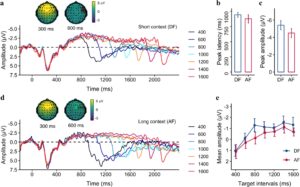
Electrophysiological signatures of temporal context
Our subjective sense of time can be influenced by different contexts, like the spacing between sample intervals and how often they appear (sample frequency). Here,…
Research
Little engagement of attention by cross-dimension distractors
While engaged in a task, it’s easy for our flow to be disrupted by salient distractors. Yet, if you know the target, shielding yourself from…
Research
Influences of temporal order in temporal reproduction
Despite the crucial role of complex temporal sequences, such as speech and music, in our everyday lives, our ability to acquire and reproduce these patterns…
Research
Asymmetric learning of dynamic spatial regularities
It is possible to improve attentional guidance by learning statistical regularities of the static spatial layout of the target and distractors within the search display.…
Long term vs. short-term distractor suppression by firefly
Research
Long-term vs. short-term distractor location effect
When a salient distractor frequently appears in one specific location, it causes less interference over time, known as the distractor-location probability cueing effect based on…
Research
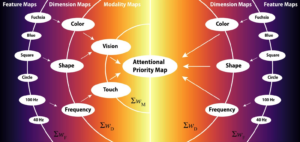
Hierarchy of intra- and cross-modal redundancy gains
Redundant information is useful for facilitating search. However, it remains controversial whether our brain integrates the features from different senses in the same way it…