 MSense
Our questions about perception, attention and time demand fine control of what reaches the senses and precise records of what the brain and the eyes do in response. The lab is equipped for that: high-refresh visual and tactile displays for psychophysics, eye-tracking, EEG and virtual reality, often combined within a single study, plus access to 3T MRI at the university’s neuroimaging core unit. Below, each setup with the kind of study it serves.
Eye-tracking and psychophysics lab
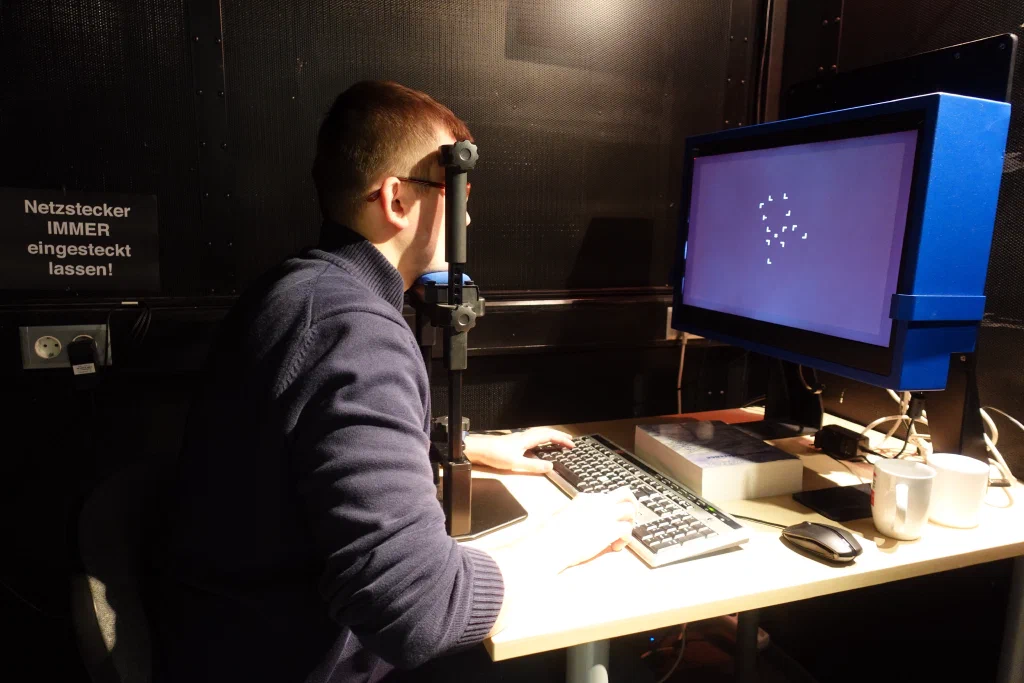
Light-sealed booths with VIEWPixx displays and desk-mounted eye-trackers are the workhorse of the lab. The displays give us frame-accurate timing and calibrated luminance, which matters whenever the question hinges on tens of milliseconds, from duration judgements to the moment a saccade starts.
The eye-tracker turns search tasks into a record of where attention went. We used it to show that people learn regular shifts of a target’s location across trials only when they become aware of the rule, and to track how observers pick up dynamic spatial patterns in search. Gaze-contingent displays let us ask what is learned about a scene when only the part under the eyes is visible, and saccade-locked presentation reveals how a single eye movement stretches and compresses perceived time.
EEG and visuo-tactile lab
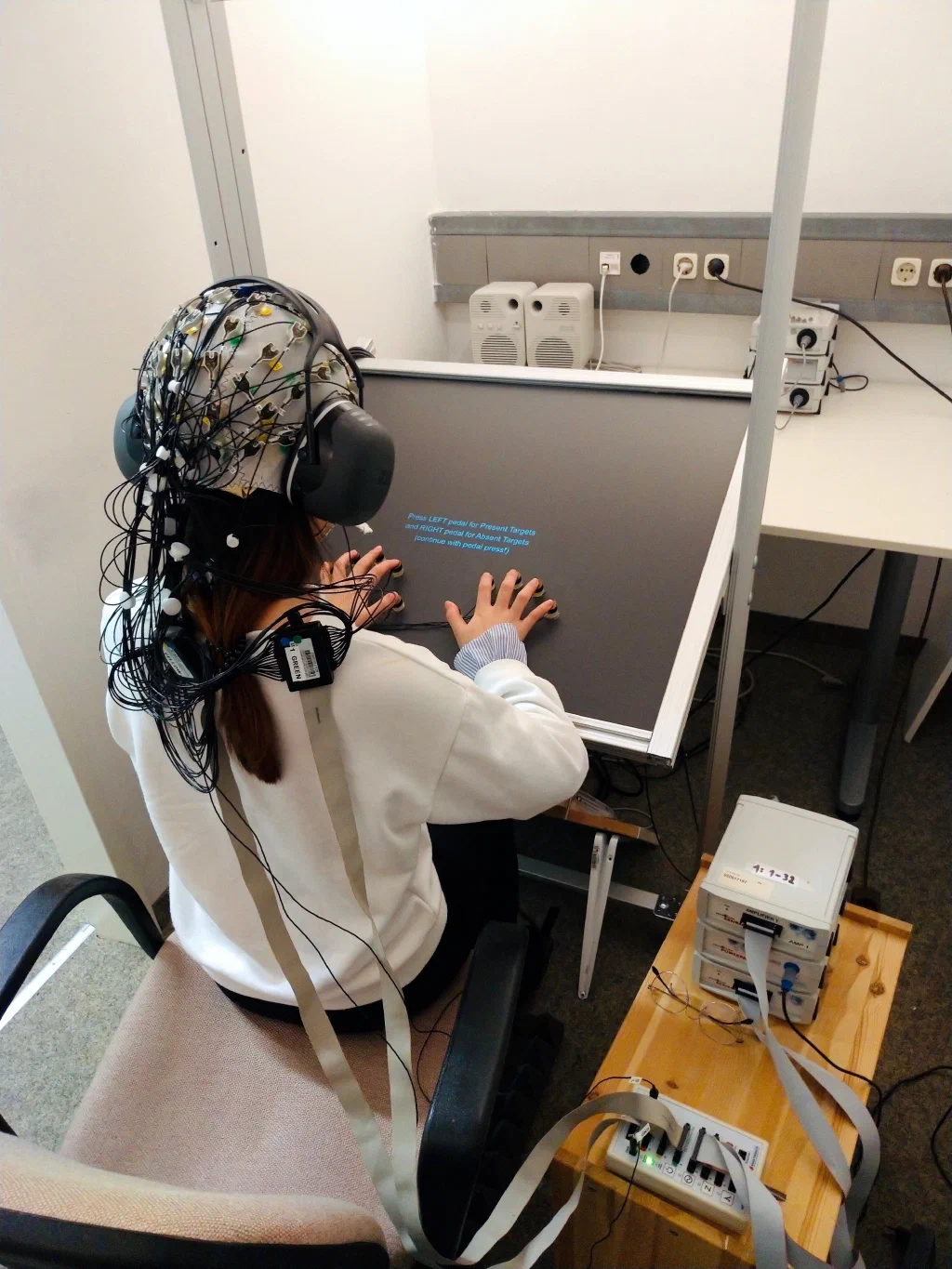
The EEG lab runs high-density recordings alongside the same visual displays used in the behavioural booths, and adds vibrotactile stimulators for the fingertips so that targets and distractors can arrive by touch as well as by sight. Responses go through foot pedals, leaving the hands free for the tactile array.
This combination lets us separate stages of attention that behaviour alone blurs. Event-related components such as the N2pc and the contralateral delay activity told us that distractors sharing the target’s features summon attention but do not engage it, and that learned scene regularities guide attention toward targets and suppress distractors through distinct neural mechanisms. The same recordings capture the slow potentials that index timing, which showed how blocked versus interleaved ranges of intervals reshape time perception. The visuo-tactile array underpins our work on cross-modal redundancy gains and on contextual memories that form across vision and touch.
Virtual reality lab
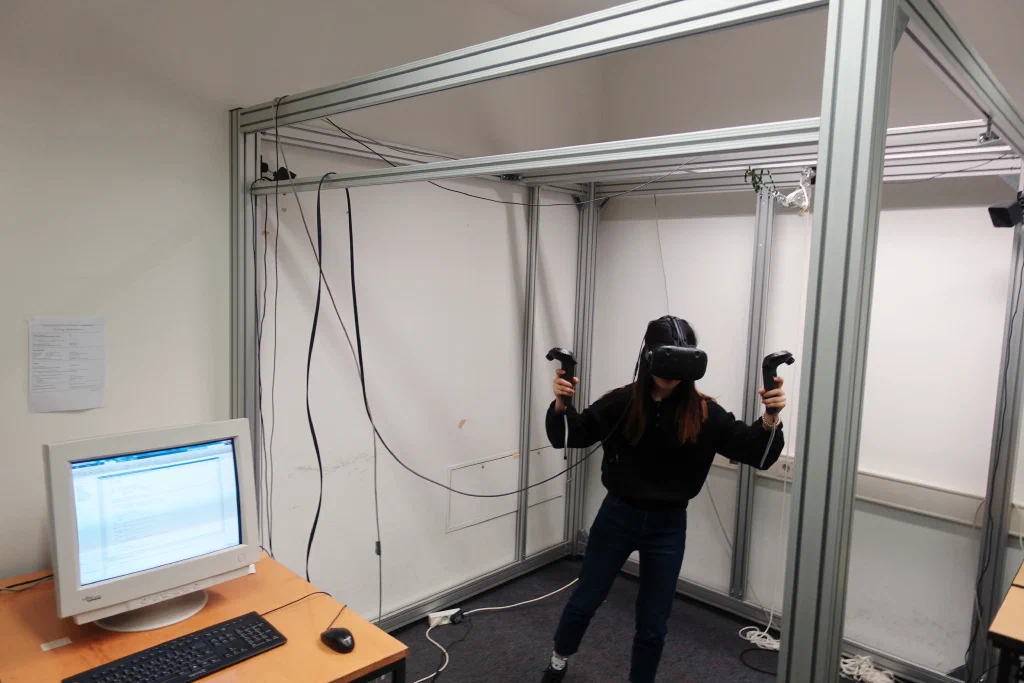
A room-scale VR setup with head and hand tracking lets us place observers inside three-dimensional scenes rather than in front of a flat screen. We use it to test whether the spatial regularities that guide search on a monitor survive in depth: contextual cueing in 3D search turned out to depend on representations defined in the picture plane, not in depth. The headset also supports studies of time perception in immersive environments, where the body moves and the scene responds.
3T MRI at NICUM
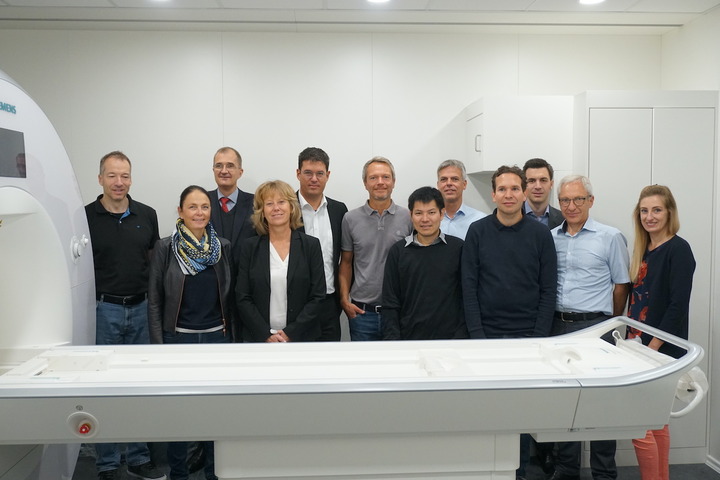
Functional imaging runs at the Neuroimaging Core Unit Munich (NICUM) on a 3T scanner, where our tasks reach the brain regions that learn and predict. Imaging revealed that the hippocampus holds distinct codes for a learned context and for its predictive association with the target, that learning where distractors tend to appear suppresses them already in early visual cortex, and that the putamen carries the trace of the previous interval that biases the next duration judgement. Our fMRI tutorial documents the analysis pipeline we use for these studies.