 MSense
 MSense Lab
We study how the mind makes sense of time, space, and uncertainty
Research in perception, attention, and Bayesian cognition — explained for everyone.
Explore by topic
Attention & context
Familiar environments help the brain focus on what matters and ignore what doesn't. Our research explores how spatial regularities, contextual cueing, and cross-modal signals shape selective attention in complex scenes.
Attention Guidance, Context Learning and Suppression

Bayesian inference
Perception is not passive; the brain constantly combines prior knowledge with new sensory evidence to form beliefs about the world. Our work examines prediction errors, prior updating, and computational models of this inferential process.
Perception as Bayesian inference
Time perception
How does the brain construct the experience of time and why does it sometimes get it wrong? Our research investigates sequential dependencies, context effects, timing models, and the neural signatures of temporal processing across seconds to minutes.
Time Perception
Curious Minds — latest
See all →
Attention & context
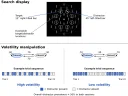
When distraction changes rapidly, we take more care before responding
Nan Qiu and colleagues report in PLOS Computational Biology that rapidly changing distractor presence is associated with more cautious responding. A pooled …
Oct 2026

Time perception
Where the last interval lingers: the putamen and duration serial dependence
Si Cheng’s fMRI study in NeuroImage: Reports finds that the previous interval lingers in the putamen, not visual cortex, when people reproduce durations, …
Oct 2026
Time perception
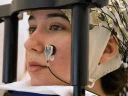
The Attentional Thief: Why an Hour of Scrolling Feels Like Half
In a stripped-down lab feed with EEG and eye tracking, a 60-second block of self-paced scrolling felt like 28 seconds, shorter than watching the same images …
Jun 2026
From the lab — latest
See all →
Research
When distraction changes rapidly, we take more care before responding
Nan Qiu and colleagues report in PLOS Computational Biology that rapidly changing distractor presence is associated with more cautious responding. A pooled …
Oct 2026
Research
Where the last interval lingers: the putamen and duration serial dependence
Si Cheng’s fMRI study in NeuroImage: Reports finds that the previous interval lingers in the putamen, not visual cortex, when people reproduce durations, …
Oct 2026
Research
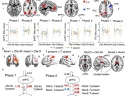
Distinct hippocampus codes for contextual cueing
Siyi Chen’s brain-imaging study in NeuroImage shows the anterior hippocampus encoding links between a repeated context and the target, the posterior …
Jan 2026
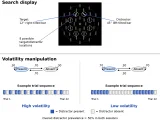
When distraction changes rapidly, we take more care before responding
Nan Qiu and colleagues report in PLOS Computational Biology that rapidly changing distractor presence is associated with more cautious responding. A pooled increase in gaze capture is no longer …
Lab news · Oct 2026

Where the last interval lingers: the putamen and duration serial dependence
Si Cheng’s fMRI study in NeuroImage: Reports finds that the previous interval lingers in the putamen, not visual cortex, when people reproduce durations, and that task switching recruits …
Lab news · Oct 2026
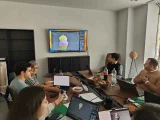
MSense hosts EyeCon VR/AR Lab Workshop II: Blender, EEG and Unity for VR research
Partners from Çanakkale spent 28 September to 2 October at LMU Munich learning to build 3D environments in Blender, analyse EEG spectra in EEGLAB and develop VR experiments in Unity, with lab practice …
Lab news · Oct 2026