Research

Papers, findings, and scientific contributions from the MSense Lab — spanning time perception, attention, and Bayesian cognition.
Research
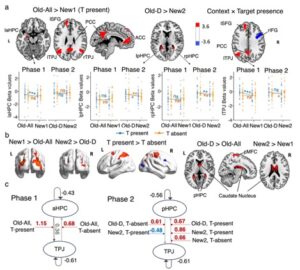
Distinct hippocampus codes for contextual cueing
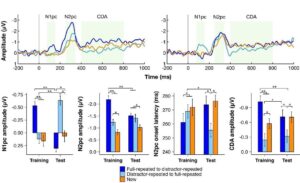
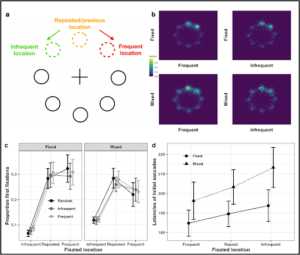
Humans can learn to use repeated visual environments to find important objects more efficiently. When the same arrangement of distracting items appears again and again,…
Research
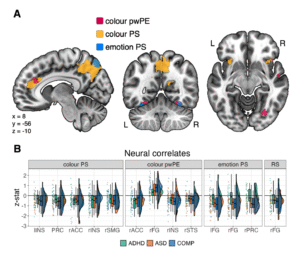
Domain-specific vs domain-general prediction errors
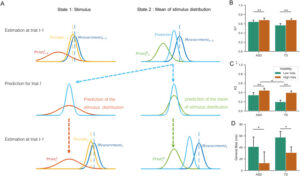
A new study by Plank and colleagues (2025) challenges previous assumptions about how individuals with autism spectrum disorder (ASD) and attention-deficit/hyperactivity disorder (ADHD) process prediction…
Research
How Distractors Summon but Do Not Engage Attention
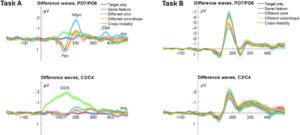
Congratulations to Dr. Shao-Yang Tsai, whose latest study has just been published in Cortex! This work investigates a fundamental question in attention research: how does…
Research
 Large-Scale Benchmarking Reveals Optimal Metrics for Measuring Functional Connectivity in Aging
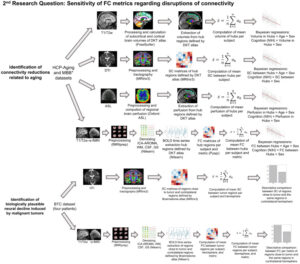
We are delighted to share that our team, collaborated with team from the imaging center NICUM, has published a comprehensive study in NeuroImage systematically comparing…
Research
Distinct Neural Mechanisms of Contextual Guidance and Suppression
We are excited to share that our lab member, Dr. Siyi Chen, has published a new paper in The Journal of Neuroscience revealing how the…
Curious Minds
How does saccade distort the time we experience?
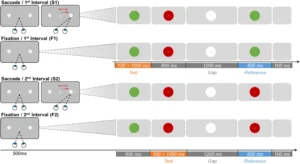
Have you ever glanced at a clock and felt like the second hand paused for a moment? This common illusion, known as the “stopped-clock” effect…
Research
Atypical Prior Updating in ASD
Our recent new study, titled “Predictive Processing in ASD: The Aytpical Iterative Prior Updating Account”, published in Biological Psychiatry Global Open Science, challenges long-held assumptions…
Research
Conscious Awareness Boosts Dynamic Regularity Learning in Visual Search
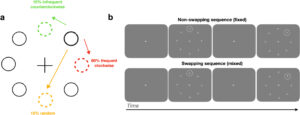
In a recent study, published in Cognition, conducted by our lab member Hao Yu, we discovered that people can learn and apply patterns in difficult…
Research
How do we learn and use dynamic spatial patterns in visual search?
Our brain has an incredible ability to adapt to changing patterns in the world around us. For instance, when searching for your keys, you might…
Research
How tasks shape temporal sequential dependence
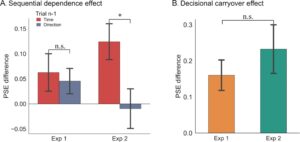
Our brain tends to let past experiences influence how we perceive new ones. For example, if you previously watched a movie for about two hours,…