Attention & context
Attention & context

Familiar environments help the brain focus on what matters and ignore what doesn't. Our research explores how spatial regularities, contextual cueing, and cross-modal signals shape selective attention in complex scenes.

29 papers • 30 posts

Posts

Research
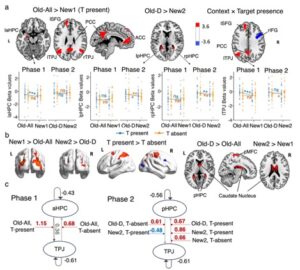
Distinct hippocampus codes for contextual cueing
Humans can learn to use repeated visual environments to find important objects more efficiently. When the same arrangement of distracting items appears again and again,…
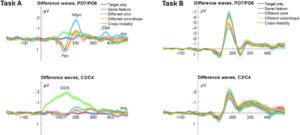
Research
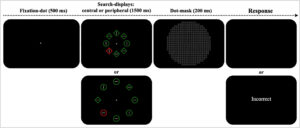
How Distractors Summon but Do Not Engage Attention
Congratulations to Dr. Shao-Yang Tsai, whose latest study has just been published in Cortex! This work investigates a fundamental question in attention research: how does…
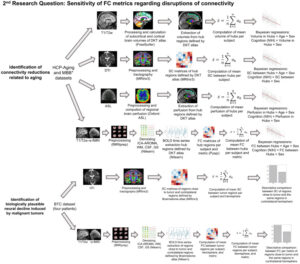
Research
 Large-Scale Benchmarking Reveals Optimal Metrics for Measuring Functional Connectivity in Aging
We are delighted to share that our team, collaborated with team from the imaging center NICUM, has published a comprehensive study in NeuroImage systematically comparing…
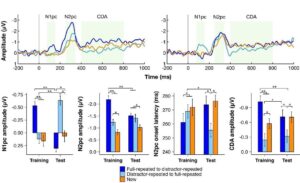
Research
Distinct Neural Mechanisms of Contextual Guidance and Suppression
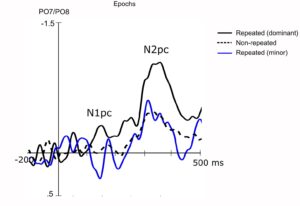
We are excited to share that our lab member, Dr. Siyi Chen, has published a new paper in The Journal of Neuroscience revealing how the…
Research
Conscious Awareness Boosts Dynamic Regularity Learning in Visual Search
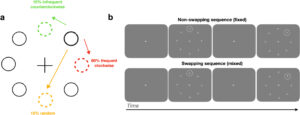
In a recent study, published in Cognition, conducted by our lab member Hao Yu, we discovered that people can learn and apply patterns in difficult…
Research
How do we learn and use dynamic spatial patterns in visual search?
Our brain has an incredible ability to adapt to changing patterns in the world around us. For instance, when searching for your keys, you might…
Research
Impact of Contextual Guidance and Suppression on Visual Search Efficiency
Context plays a pivotal role in our daily decision-making processes. For instance, when navigating a familiar city, we often rely on landmarks to guide us.…
Research
Selective contextual association
Context plays a critical role in directing our attention, as we often subconsciously learn associations between targets and their surroundings to enhance performance. The flexibility…
Lab News
Talk on Visual distractor suppression at Oldenburg University
Oldenburg, April 11 – Dr. Zhuanghua Shi recently visited Oldenburg University to give a talk on how our brains handle distractions. The talk, titled “Neural…
Research
Understanding Color Perception: How Natural Daylight Cues Influence Hue Discrimination
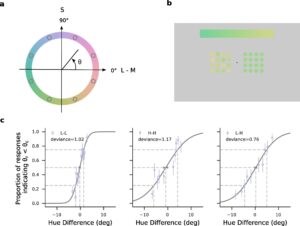
Incorporating statistical properties of stimuli into the interpretation of sensory data can greatly enhance the accuracy of perception amidst noisy input; however, it can also…
Lab News
Workshop on “Predictive Attention” Yields Insightful Discussions
Dr. Siyi Chen, a junior resident at LMU CAS, orchestrated a two-day workshop (18-19 March, 2024) that brought together leading scientists to explore the concept…
Research
High demand redirects increased anxiety to uphold goal-directed attention
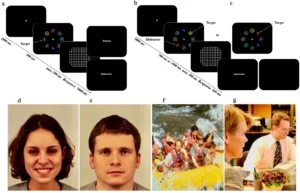
Recently Stanković et al. (2024) used a novel dual-target search paradigm to investigate influence of state anxiety on stimulus-driven attentional capture. And we found that…
Curious Minds
Eye movement: innovation in visual perception training
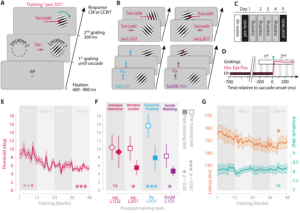
News from the original LMU Newsroom: Constant training improves the capacities of human perception. Just as years of practice hone the senses of smell and…
Curious Minds
Feng Meng, can the ability to see a flea as large as a wheel be transferred?
Feng Meng, can the ability to see a flea as large as a wheel be transferred? Our team member Dr. Lukasz Grzeczkowski has recently revealed in…
Research
Valence color preference and association
Research has found that emotion-associated features, such as color, can influence our attention. However, what has been neglected is individuals may have their own color-valence…
Research
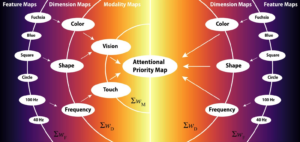
Little engagement of attention by cross-dimension distractors
While engaged in a task, it’s easy for our flow to be disrupted by salient distractors. Yet, if you know the target, shielding yourself from…
Research
Asymmetric learning of dynamic spatial regularities
It is possible to improve attentional guidance by learning statistical regularities of the static spatial layout of the target and distractors within the search display.…
Long term vs. short-term distractor suppression by firefly
Research
Long-term vs. short-term distractor location effect
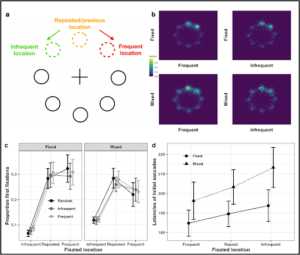
When a salient distractor frequently appears in one specific location, it causes less interference over time, known as the distractor-location probability cueing effect based on…
Research
Hierarchy of intra- and cross-modal redundancy gains
Redundant information is useful for facilitating search. However, it remains controversial whether our brain integrates the features from different senses in the same way it…
tactile search by midjourney
Research
Statistical context learning in tactile search
When searching for an object, our brains learn to associate its location with other surrounding objects, known as contextual cueing. The fixed contextual configuration thus…
1 2