Attention & context
Attention & context

Familiar environments help the brain focus on what matters and ignore what doesn't. Our research explores how spatial regularities, contextual cueing, and cross-modal signals shape selective attention in complex scenes.

29 papers • 30 posts

Posts

Research
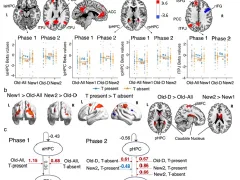
Distinct hippocampus codes for contextual cueing
Siyi Chen’s brain-imaging study in NeuroImage shows the anterior hippocampus encoding links between a repeated context and the target, the posterior hippocampus encoding relations among …
Research
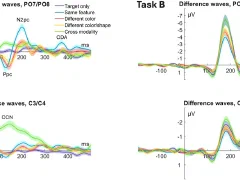
How Distractors Summon but Do Not Engage Attention
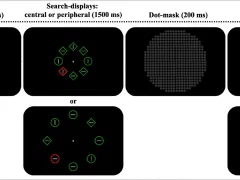
Shao-Yang Tsai’s high-density EEG study in Cortex shows that distractors sharing the target’s critical features capture spatial attention, marked by a larger N2pc, yet evoke no late PD, …
Research
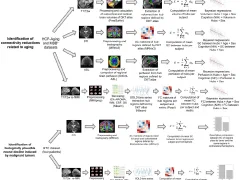
 Large-Scale Benchmarking Reveals Optimal Metrics for Measuring Functional Connectivity in Aging
Benchmarking 20 resting-state fMRI connectivity metrics on 1187 participants, a NeuroImage study with NICUM finds correlational and distance-based measures most sensitive to age-related connectivity …
Research
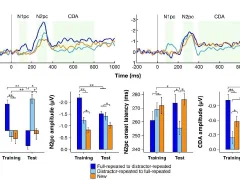
Distinct Neural Mechanisms of Contextual Guidance and Suppression
Siyi Chen’s EEG study in The Journal of Neuroscience shows that a predictive distractor layout triggers a guidance mode with N1pc, N2pc and CDA signatures, while a non-predictive layout switches …
Research
Conscious Awareness Boosts Dynamic Regularity Learning in Visual Search
Hao Yu’s eye-tracking study in Cognition shows that people who consciously noticed the target’s predictable shift in serial search sent their first saccade to the predicted location, …
Research
How do we learn and use dynamic spatial patterns in visual search?
When a search target shifted to an adjacent position on 80 percent of trials, about 70 percent of participants learned the pattern, but only those aware of it searched faster with fewer saccades.
Research
Impact of Contextual Guidance and Suppression on Visual Search Efficiency
Siyi Chen’s visual search study in Psychonomic Bulletin & Review shows that learned context-target associations speed search strongly but break down when reversed, whereas context …
Research
Selective contextual association
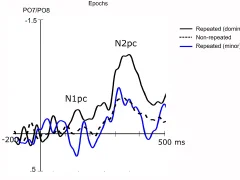
EEG recordings by Artyom Zinchenko and Xuelian Zang show that repeated distractor layouts speed search only for one dominant target, marked by early N1pc and N2pc, while a second target evokes a later …
Lab News
Talk on Visual distractor suppression at Oldenburg University
At Oldenburg University, hosted by Prof. Hans Colonius, Dr. Zhuanghua Shi presented EEG and fMRI evidence that same-dimension distractors slow search and dampen the N2pc, while cross-dimension color …
Research
Understanding Color Perception: How Natural Daylight Cues Influence Hue Discrimination
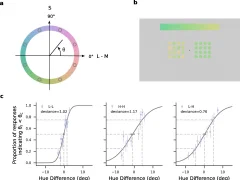
Hue discrimination is most accurate and least biased along the color axis matching natural daylight; a Bayesian observer model with a prior favoring blue tones explains the pattern, published in …
Lab News
Workshop on “Predictive Attention” Yields Insightful Discussions
Dr. Siyi Chen of LMU CAS gathered speakers from Lancaster, Oxford, Nijmegen, Peking, Columbia and Amsterdam for a two-day workshop, 18-19 March 2024, debating how our minds anticipate and react to the …
Research
High demand redirects increased anxiety to uphold goal-directed attention
Experimentally raised state anxiety left dual-target search performance unchanged: high task demand and working memory load appear to redirect anxiety and keep attention goal-directed rather than …
Curious Minds
Eye movement: innovation in visual perception training
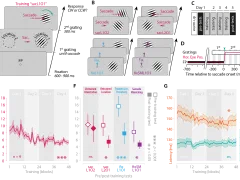
Training vision while the eyes move lets perceptual learning spread beyond the trained spot to untrained parts of the visual field, LMU Newsroom reports on the PNAS study by Grzeczkowski, Shi, Rolfs …
Curious Minds
Feng Meng, can the ability to see a flea as large as a wheel be transferred?
Lukasz Grzeczkowski shows in PNAS that perceptual learning transfers to a new location when the eyes saccade there, though not to a new feature, told through the Chinese myth of archer Feng Meng.
Research
Valence color preference and association
Stanković and colleagues found no overall effect of emotion-color association on task performance, but each participant’s own valence preference for red or green shaped how a task-irrelevant …
Research
Little engagement of attention by cross-dimension distractors
Tsai et al. varied salient distractors while holding the target fixed: only a distractor sharing the target dimension interfered and reduced the N2pc; cross-dimensional and cross-modal distractors …
Research
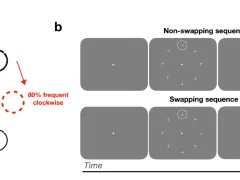
Asymmetric learning of dynamic spatial regularities
Yu and colleagues shifted the target or a distractor one step clockwise or counterclockwise across trials and found robust learning of the predictable target location but little proactive suppression …
Research
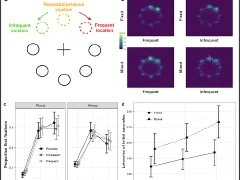
Long-term vs. short-term distractor location effect
Using lateralized ERPs in the additional-singleton paradigm, Qiu and colleagues tied statistically learnt distractor-location suppression to an early N2pc and inter-trial suppression to an enhanced …
Research
Hierarchy of intra- and cross-modal redundancy gains
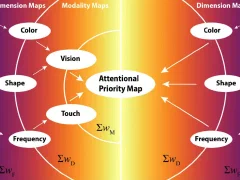
In visuo-tactile search, Nasemann and colleagues found the PCN EEG component sensitive to redundant features across modalities. Its amplitude and timing explained about 25% of RT variance, supporting …
Research
Statistical context learning in tactile search
Chen et al. found that adding a redundant visual context to tactile search brings no extra contextual-cueing benefit, suggesting that the task-critical modality sets the reference frame for context …
Research
Distractor suppression in the early visual cortex
Combining probability-cueing visual search with fMRI, Bei Zhang and colleagues linked reduced interference from frequent-location distractors to suppressed distractor-evoked activity in early visual …
Research
Does distractor frequency in one region affect distractor suppression in another region?
Allenmark and colleagues varied distractor prevalence across display regions and found that interference in one region was unaffected by distractor frequency in the other, pointing to purely local …
Research
Contextual cueing in co-active visual search: Joint action allows acquisition of task-irrelevant context 
Searching side by side with a partner lets people learn repeated display layouts relevant only to the partner, a context solo searchers fail to acquire. Published in Attention, Perception & …
Research
Cross-modal contextual memory guides selective attention in visual-search tasks
ERPs show that repeated tactile distractor layouts speed visual search as much as repeated visual ones, and both boost the same attentional-selection (PCN) and target-analysis (CDA) stages. Published …