Bayesian inference
Bayesian inference

Perception is not passive; the brain constantly combines prior knowledge with new sensory evidence to form beliefs about the world. Our work examines prediction errors, prior updating, and computational models of this inferential process.

6 papers • 5 posts

Posts

Research
Domain-specific vs domain-general prediction errors
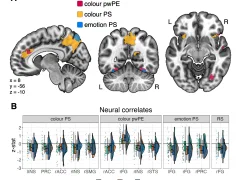
Plank and colleagues find in Imaging Neuroscience that adults with ASD, ADHD and neurotypical controls show no differences in prediction-error signals for the colors and emotions of unattended faces, …
Research
Atypical Prior Updating in ASD
In a duration reproduction task, individuals with ASD updated their prior expectations more strongly from each new sensory input than controls, especially in volatile settings, challenging the …
Research
Reference induced biases in late visual processing
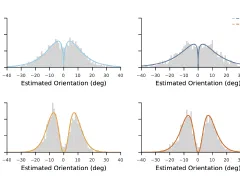
Yannan Su et al. showed that an orientation reference presented after an ensemble stimulus still repels reproduced orientations, especially in a dual task, and an encoding-decoding model with …
Research
Perceptual biases and Individual beliefs
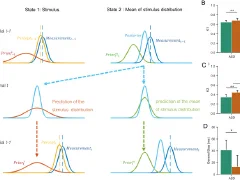
A two-state Bayesian model from Glasauer and Shi explains why people differ in central tendency and sequential biases: implicit beliefs about temporal continuity set how much each person leans on …
Research
Inter-trial effects in priming of pop-out: Comparison of computational updating models
Evidence-accumulation models with competing updating rules, fitted to priming-of-pop-out data, trace color and position priming to a shared weight resource setting accumulation rate, and response …