Time perception
Time perception

How does the brain construct the experience of time and why does it sometimes get it wrong? Our research investigates sequential dependencies, context effects, timing models, and the neural signatures of temporal processing across seconds to minutes.

25 papers • 26 posts

Posts

Curious Minds
Your phone steals time twice
You pick up your phone to check one message. An hour later, you look up — shocked. Where did the time go? And when you…
Curious Minds
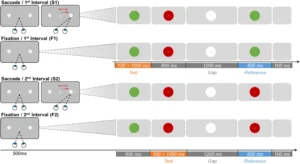
How does saccade distort the time we experience?
Have you ever glanced at a clock and felt like the second hand paused for a moment? This common illusion, known as the “stopped-clock” effect…
Curious Minds
TEDx talk on decisions under time pressure
Have you ever wondered why we often make snap decisions under pressure, even when they mislead us? Last year, I shared my thoughts at TEDxTUM…
Research
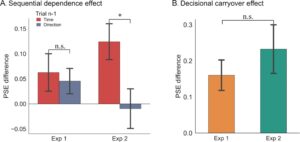
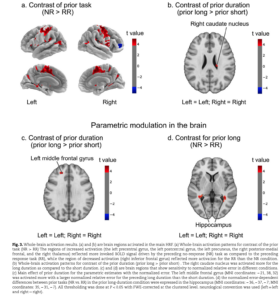
How tasks shape temporal sequential dependence
Our brain tends to let past experiences influence how we perceive new ones. For example, if you previously watched a movie for about two hours,…
Research
Opposing sequential biases in time and direction perception
Our recent experiences influence how we perceive and make decisions, a concept known as serial dependence. While this has been studied in how we see…
Research
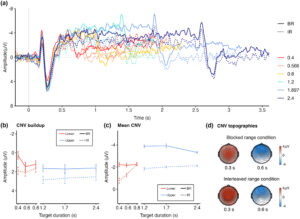
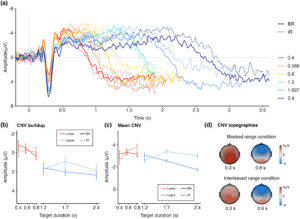
Blocked versus interleaved: How range contexts modulate time perception and its EEG signatures
Understanding time accurately is vital for many cognitive processes. People’s time estimates often converge around the average when presented with various intervals. Although prior research…
Lab News
Talk on Understanding Time at Mainz University
On June 12 in Mainz, Dr. Z. Shi delivered a lecture at Mainz University on how we perceive time. During his talk, titled “Understanding time:…
Research
How range contexts modulate time perception and its EEG signatures
A recent study, led by our former team member, Dr. Cemre Baykan, titled “Blocked versus interleaved: How range contexts modulate time perception and its EEG…
Curious Minds
New insights into Vierordt’s law: A talk by Prof. John Wearden
It’s a pleasure to have Prof. John Wearden in Munich to give a talk on Vierordt’s Law (1868). In a compelling presentation, Professor John Wearden…
Research
Influence of Temporal and Probabilistic Expectation on Subjective Time of Emotion Stimulus
Subjective time perception fluctuates with a stimulus’s valence and expectancy. Karaaslan and Shi’s (2024) research examined how temporal and probabilistic expectancies affect the duration perception…
Research
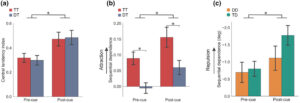
Influence of Action on Sequential Dependence
Our perception and decision-making are susceptible to prior context. In our recent study, published in Cerebral Cortex, Ms. Cheng and colleagues employed functional magnetic resonance…
Curious Minds
TEDxTUM talk on “Hidden time cues shape our decisions”
Hidden time cues, they are silently woven into every moment of our lives. How do these invisible time fibers subtly manipulate our daily choices and…
Research
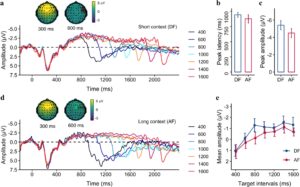
Electrophysiological signatures of temporal context
Our subjective sense of time can be influenced by different contexts, like the spacing between sample intervals and how often they appear (sample frequency). Here,…
Research
Influences of temporal order in temporal reproduction
Despite the crucial role of complex temporal sequences, such as speech and music, in our everyday lives, our ability to acquire and reproduce these patterns…
Research
Context in temporal decision making
“During a lunch break, you open a cup of instant noodles, pour hot water over the noodles, cover, and wait. Time to open depends on…
Beyond Scalar Timing, Midjourney
Research
Beyond Scalar timing theory
Since the classical internal clock model, the timing theory is characterized by the scalar property. This property refers to time estimation following Weber’s law, which…
generated by MidJourney
Research
Oscillation models of reward-related timing
Recent advancements in the field of timing and time perception have paved the way for an insightful integration of interval timing, decision making, reinforcement learning,…
Curious Minds
The 150-Year-Old Mistake That Taught Us How the Brain Keeps Time
Try this. Tap your finger twice on a table, making two short intervals of sound. Then do it again, but make the second interval noticeably…
Research
V5/MT+ modulates spatio-temporal integration differently across and within hemifields: causal evidence from TMS
A latest publication by Artyom, Stephanie, Lingyue et al. on Neuropsychologia on the topic on TMS modulates Ternus apparent motion. Abstract It is unclear how…
Research
The origin of Vierordt’s law: The experimental protocol matters
Glasauer, S., & Shi, Z. (2021). The origin of Vierordt’s law: The experimental protocol matters. PsyCh Journal, pchj.464. https://doi.org/10.1002/pchj.464 Abstract In 1868, Karl Vierordt discovered one type…
1 2