 MSense
 A new study from the MSense Lab at LMU Munich, currently under peer review. The findings below are preliminary and have not yet completed the review process.
You know the feeling. You reach for your phone to check one thing. You look up, and the evening is gone. Where did it go?
Time is not something we sense. We see light, we hear sound. For time there is no organ at all. To know how long something lasted, you have to attend to time itself, to watch a kind of inner clock that ticks only while you look at it. A feed is built to take that attention and give nothing back. So the minutes slip past uncounted. And they slip past fast.
We wanted to know whether one feature of scrolling, the plain act of choosing when to move on, is enough by itself to make time disappear. So we built a stripped-down feed. No rewards. No social signals. No algorithm. Just pictures, and a choice.
A feed in the lab
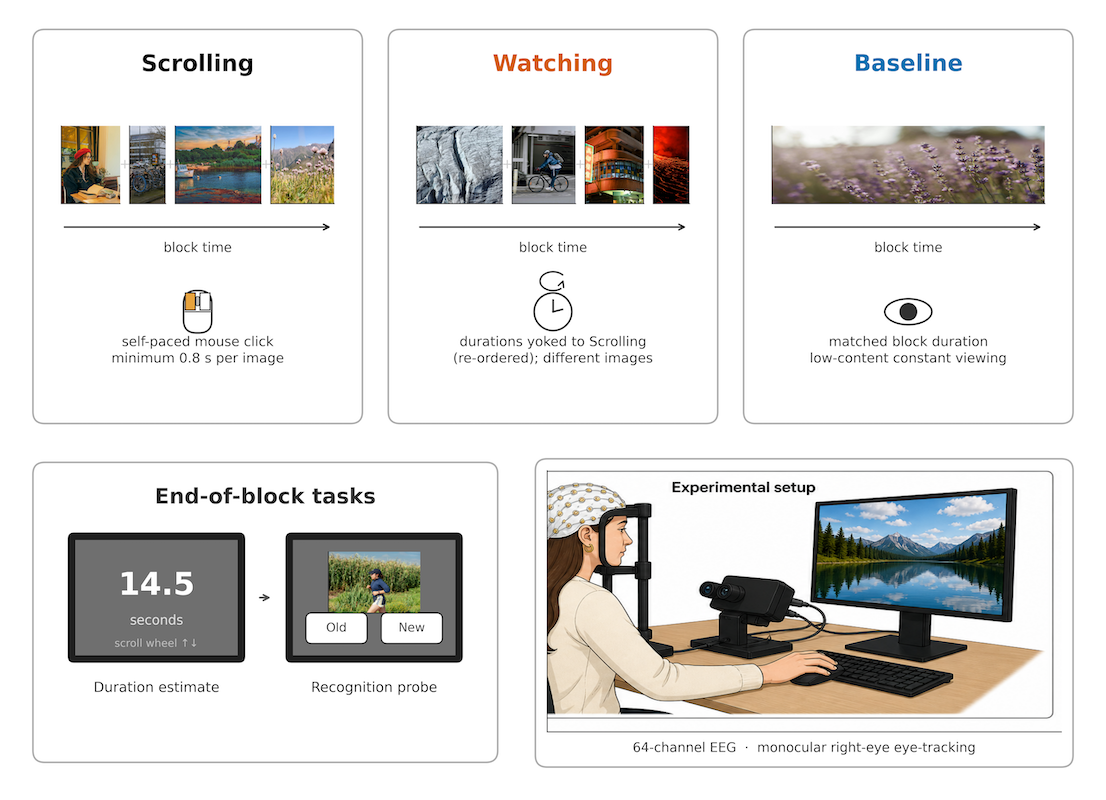
The three conditions. In Scrolling, participants advanced at their own pace; in Watching, the same images replayed at the same speed but out of their hands; in Baseline, a single calm image held the screen. After each block they estimated how long it had lasted.
We showed 23 people streams of photographs under three conditions. In Scrolling, they advanced at their own pace, one click at a time, the way a thumb moves through a feed. In Watching, the same images returned at the same speed, only now the pace had left their hands, replayed from an earlier scrolling session. In Baseline, a single calm image held the screen for the same stretch of time. After each block we asked one question: how long did that last? Meanwhile, we recorded their EEG and tracked their eye movements.
In the design, every person is matched against themselves, active scrolling against a passive replay of the very same pictures. Whatever separates the two cannot come from the content, because the content is balanced.
Half your time, gone
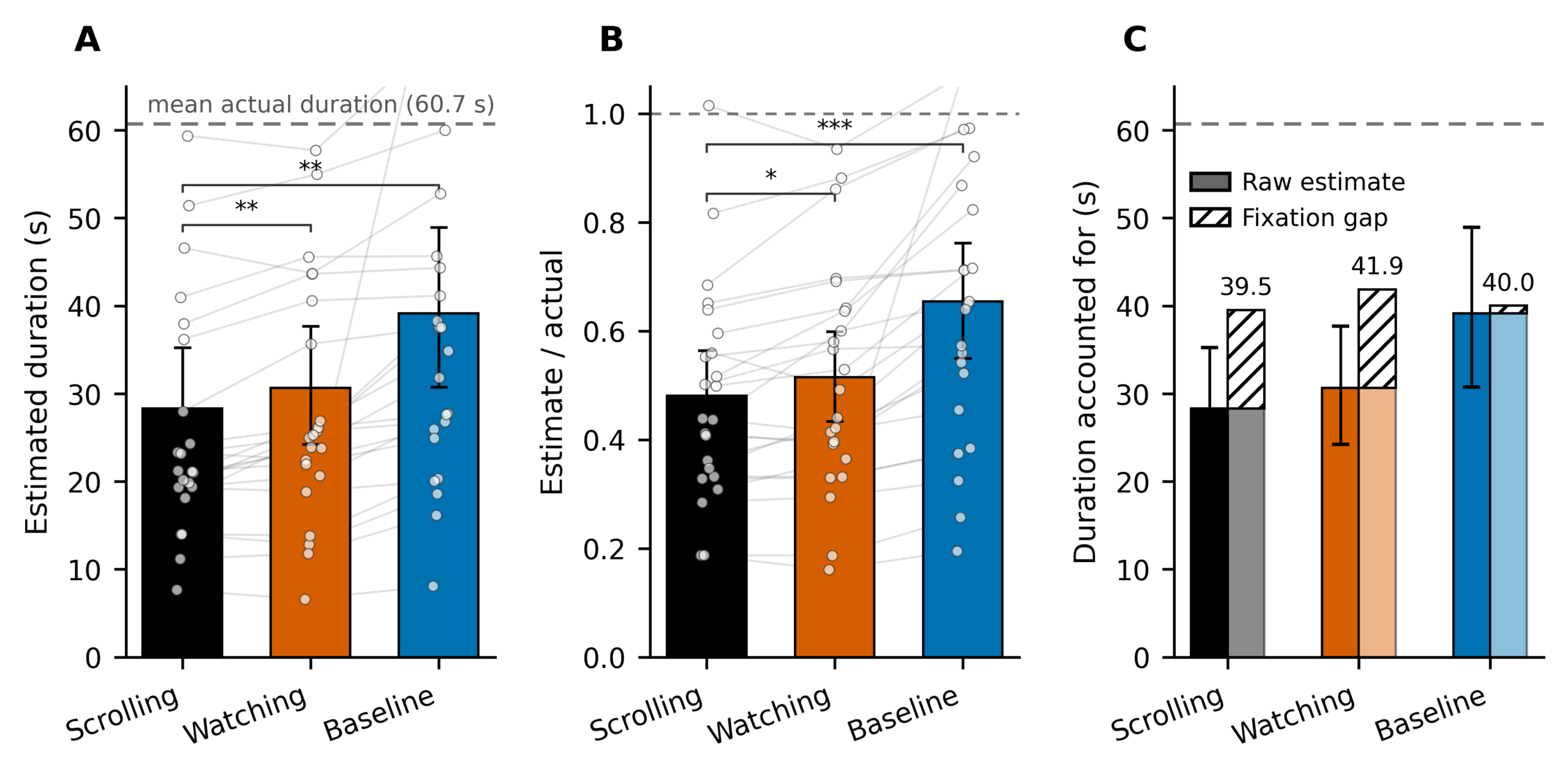
Each block really lasted about 60 seconds (dashed line). People felt far less, and least of all when they scrolled.
The blocks ran about a minute. But people felt far less.
Scroll at your own pace, and a 60-second block shrank to about 28 seconds. Less than half. Watch the same images play back, and it stretched only a little, to about 31. Even the single static image, the dullest condition of all, felt like just 39 seconds. Boredom, it turned out, came closest to honest time.
Two thieves are at work here.
The first hides in the blank spaces between images. Real feeds are full of them: a loading pause, the half-second before a clip begins to play, a flash of ad before the content. When we added that uncounted gap time back into people’s estimates, the difference between the picture conditions and the dull baseline almost closed. People timed the pictures and barely counted pauses and gaps. In a real feed those pauses stack up all evening, one reason the clock outruns the hour you feel.
The second thief is your own action. Even after the gaps were accounted for, scrolling still felt shorter than watching, by two to three seconds in a single minute-long block, with the pictures and their timing held identical. One thing alone set the two apart: who held the pace. Holding the advance in your own hand costs you seconds. Two or three sounds like nothing. Yet it holds across people, it comes purely from being in control, and over an evening of self-paced scrolling it compounds.
More effort, no more memory
Here is where the brain plays its quiet trick. Taking the wheel asks for more. More decisions, more attention, busier eyes. The eye-tracking shows it at a glance: while scrolling, people threw faster, larger jumps across each picture and rested on each one for less time. They scanned. They did not settle.
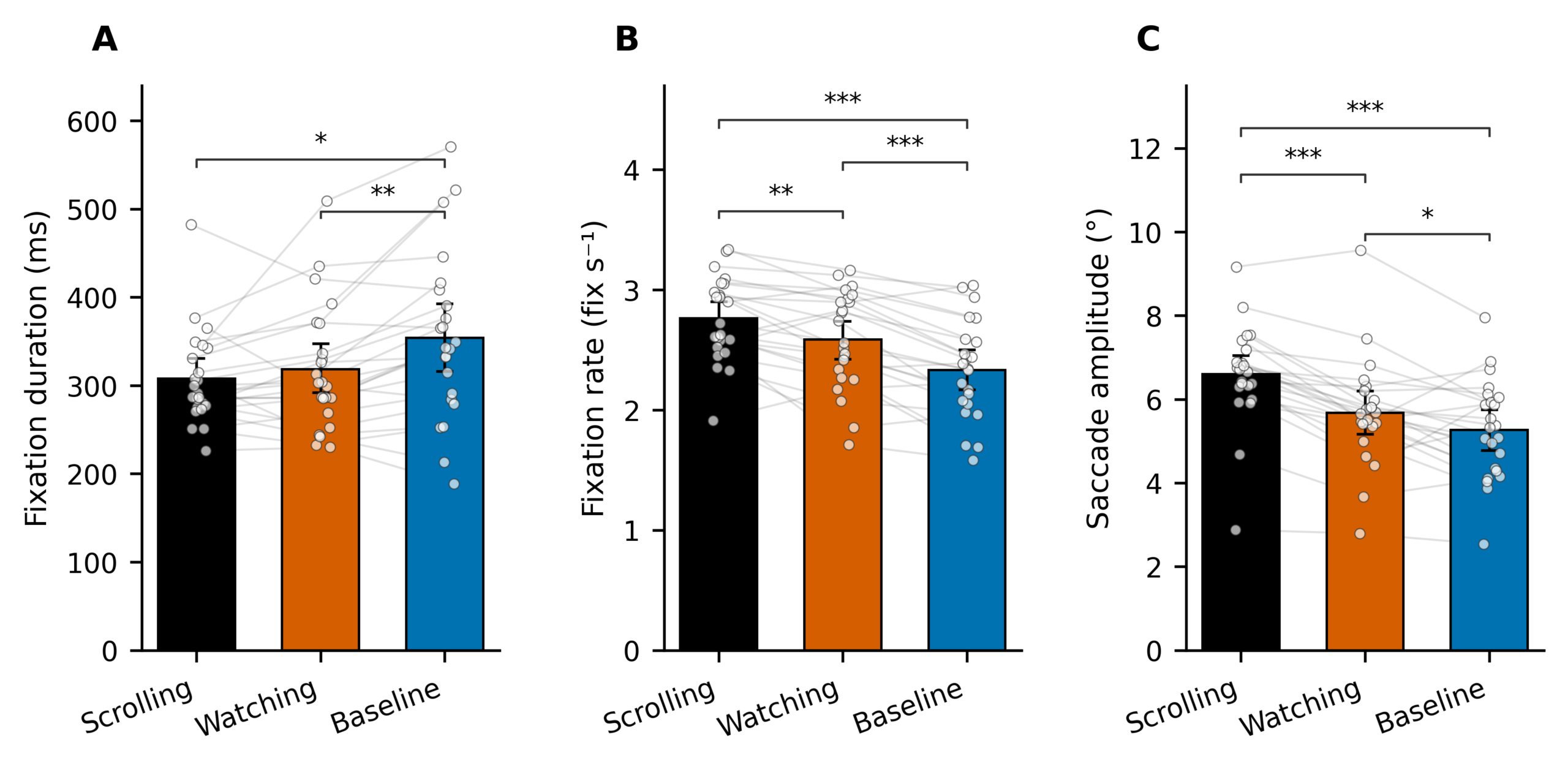
Scrolling means busier eyes: shorter fixations, more of them each second, and bigger jumps across the image.*
All that effort should buy richer memories. It does not. When we tested later what people remembered, recognition held essentially level whether they had scrolled or watched.. That apparent surge during scrolling sat in the moment before each image arrived, a flicker of anticipation, the brain bracing for the picture it had summoned, not a deeper process of the picture itself. More effort, more attention, but not more things to remember. That is the trick.
The thief, in the end, is attention. Looking, deciding when to move on, bracing for what comes next: each one pulls attention off the clock, and felt time shrinks to whatever is left over to count.
What I take from this
A few thoughts now, in my own voice.
Attention has no clean off-switch. Put the phone down, and part of your mind keeps scanning for the next thing for minutes afterward. Researchers call it attentional residue. The phone need not even be in your hand: studies have shown that one lying face-down and silent on the desk still lowers attention on the task in front of you. Your brain knows it is there. When I have to concentrate, the phone leaves the room. Not the pocket, not face-down on the table. But in the next room or corridor. This is not willpower. It is a few seconds of friction, placed so the easy choice becomes the focused one.
And the cure cannot live on the phone. A walk is almost the perfect anti-feed. The feed is a jumpy, self-paced stream that drags your gaze onto a screen and off the clock; a walk unfolds on its own, at the world’s pace, and turns your attention gently outward, to trees, to light, to movement. That is the very attention a feed exhausts and a walk restores. It also lays down a real memory, a landmark in the day, so the day does not collapse into nothing.
—
The Attentional Thief was led by Chunyu Qu, with Artyom Zinchenko, Siyi Chen, and Zhuanghua Shi at the MSense Lab, LMU Munich, and supported by the German Research Foundation (DFG).
Related news:
- 3sat science programme nano on time perception and digital media (starts around 20:00).
- LMU University News
- Der Spiegel: Was? Schon so spät?