 MSense
 Try this. Tap your finger twice on a table, making two short intervals of sound. Then do it again, but make the second interval noticeably longer. Most people report that the second pair felt different — even if the intervals were physically identical. Your brain didn’t record what happened. It predicted what would happen, and got fooled.
It’s a window into how the mind constructs time — and the story behind it begins with a 19th-century professor in Tübingen who accidentally stumbled onto one of the deepest puzzles in perception science.
A professor, a clicking machine, and a very odd result
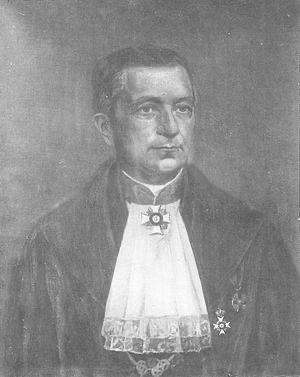
In 1868, Karl von Vierordt published a book called Der Zeitsinn nach Versuchen — roughly, The Sense of Time According to Experiments. He had spent years in his Tübingen laboratory doing something deceptively simple: his assistant would produce a time interval by clicking twice, and Vierordt would try to reproduce it. He did this over a thousand times, across intervals ranging from a quarter of a second to nearly nine seconds.
The pattern that emerged was striking. Short intervals — he consistently reproduced them as longer than they were. Long intervals — he reproduced them as shorter. Everything pulled toward the middle, toward some invisible average. This became known as Vierordt’s law, and it haunted time perception research for the next 150 years. Why would the brain systematically distort time in this particular way?
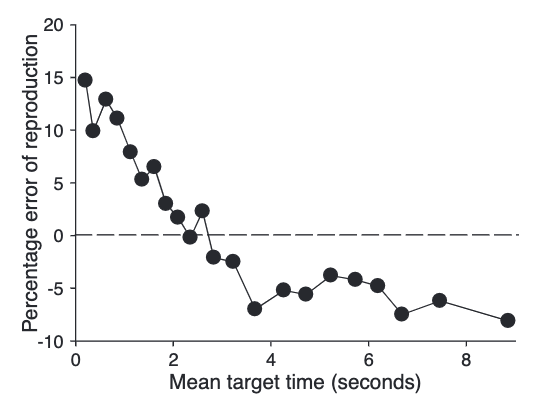
For most of that time, nobody had a good answer. One review from 2009 called it a problem that “currently defies any coherent theoretical treatment.”
The mistake hiding in plain sight
Stefan Glasauer and Zhuanghua Shi took a fresh look — not at Vierordt’s results, but at his method.
What they found was surprising. Vierordt had presented his intervals in a random order: a short one, then a very long one, then a medium one, then a short one again. Large jumps, no pattern, complete unpredictability. He thought this was rigorous science. In fact, it was the worst possible thing he could have done — because the brain is not built for random sequences.
Think about how time unfolds in the real world. The speed of a passing car changes gradually. Birdsong comes in rhythmic bursts. Your own walking pace varies smoothly. Durations in nature follow what mathematicians call a random walk — each moment is close to the previous one, drifting slowly rather than jumping wildly. Your brain has been shaped by this regularity. It assumes the next moment will be roughly like the last one, and uses that assumption to sharpen its estimates.
Vierordt’s random sequence violated this assumption completely. With every trial, the brain tried to anchor its estimate to what it had just experienced, only to find that the last interval was no reliable guide to the next. The result: everything got pulled toward the average of all the intervals the brain had been exposed to. Short intervals seemed longer, long ones seemed shorter.
It wasn’t a law of time perception at all. It was a measurement artifact — a consequence of an experimental protocol that doesn’t resemble how time actually works in life.
What happens when you fix the protocol
To test this, we ran a new experiment. They gave participants the same set of durations, but in two different orders: one randomized (like Vierordt’s), the other arranged as a proper random walk — smoothly drifting up and down. Same durations. Same participants. Just different sequence.
The result was dramatic. The classic Vierordt distortion — short overestimated, long underestimated — appeared strongly in the random condition, and nearly vanished in the random-walk condition.
The brain, it turns out, is a prediction machine. It constantly updates an internal model of “what duration should I expect next?” using a process closely related to Bayesian inference — the mathematical framework for combining prior expectations with new evidence. When the sequence is predictable (even loosely, like a random walk), the model updates accurately and perception stays sharp. When the sequence is chaotic, the model averages everything together, and Vierordt’s law emerges.
What this means for how you experience time
The deeper lesson here is not about laboratory clicks. It’s about the nature of perception itself. We don’t passively receive time — we construct it, moment by moment, using predictions built from everything that came before. The brain is always asking: given what just happened, what should I expect now?
This is why waiting in line feels longer than it should — your predictions keep being violated. It’s why music carries you forward — its rhythmic structure makes each moment feel inevitable. And it’s arguably why time seems to compress when you’re scrolling through a feed: the endless novelty collapses your brain’s ability to anchor expectations, flattening an hour into what feels like minutes.
Vierordt thought he was measuring a property of human time sense. He was actually revealing the machinery underneath — a machinery that, 150 years later, we’re only just beginning to understand.
the original paper: Glasauer & Shi (2021), “The origin of Vierordt’s law: The experimental protocol matters”, PsyCh Journal. Read the full paper