MSense

Distinct hippocampus codes for contextual cueing
Siyi Chen’s brain-imaging study in NeuroImage shows the anterior hippocampus encoding links between a repeated context and the target, the posterior hippocampus encoding relations among …
Jan 5, 2026Our research spans three questions about how the mind makes sense of the world. How does the brain construct the experience of time — and why does it sometimes get it wrong? How do we learn to focus on what matters and ignore what doesn’t? And how does the brain combine prior knowledge with new evidence to form perceptual beliefs? Explore each topic below.
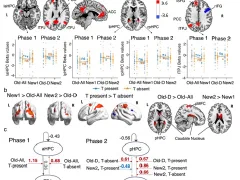
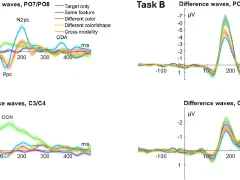
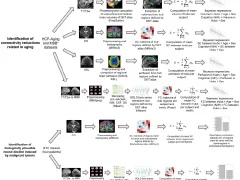
Our newest studies ask how the brain turns the regularities of a scene into efficient search, and what happens when a regularity stops paying off. Imaging showed that the hippocampus keeps separate codes for a learned context and for its predictive link to the target, and EEG revealed distinct lateralised signatures for guidance toward a predicted target versus suppression of a familiar distractor layout. Distractors that share the target's critical features summon attention yet fail to engage it. People learn dynamic cross-trial rules in search only once they become aware of them. New preprints connect distractor suppression to environmental volatility, pre-stimulus cortical state and moment-to-moment alertness.
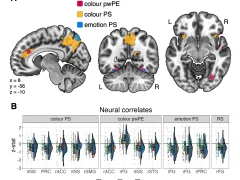
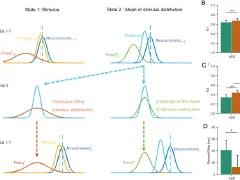
Recent work tests how priors form and update, and where this differs in autism. A two-state Bayesian model of duration reproduction showed that people with autism keep their experiential priors intact but update them faster from sensory input, most of all in volatile environments. Neural correlates of precision-weighted prediction errors for colours and emotional faces did not differ between autism, ADHD and controls, and a preregistered study of emotional-valence prediction in autism within the Bayesian-brain framework appeared in Molecular Autism. A new preprint proposes precision-weighted updating as one account of serial dependence across sensory and contextual transitions.
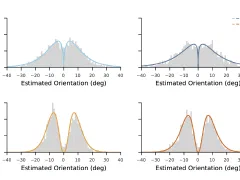
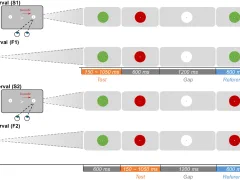
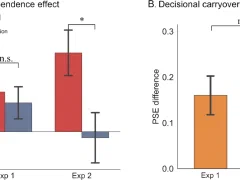
Serial dependence runs through our newest timing studies: the interval you just experienced pulls your next judgement toward itself. fMRI located that trace in the putamen, where the prior duration is suppressed, rather than in visual cortex. The pull needs consistent motor responses, not shared memory alone, grows with how deeply an action is bound to the interval, and shifts with arousal. Saccades distort time in two directions, stretching the first event after the eye lands and compressing the next, and self-paced exploration of a screen compresses subjective time, which is why an hour of scrolling can feel like half.