 MSense
A more changeable visual environment can slow our responses without measurably changing what first draws our eyes, once recent repetition history is taken into account. Our new study, led by Nan Qiu and published in PLOS Computational Biology on 21 October 2026, separates these two effects: where gaze goes first, and how much checking happens before a response.
The distinction matters because a slower response does not necessarily mean that a distraction was harder to ignore. It can also mean that someone took more care before deciding.
Same distractor frequency, different patterns
We analysed data from 21 adults who searched for a slightly tilted bar among vertical bars and reported whether its notch was at the top or bottom. An irrelevant, more strongly tilted bar appeared on half the trials. Eye tracking recorded where participants looked throughout the search.
Each person completed two sessions. In one, distractor presence and absence switched frequently; in the other, each state tended to persist. The overall frequency of distraction stayed at 50%. What changed was volatility: how often the environment moved between states, rather than how often a distractor appeared.
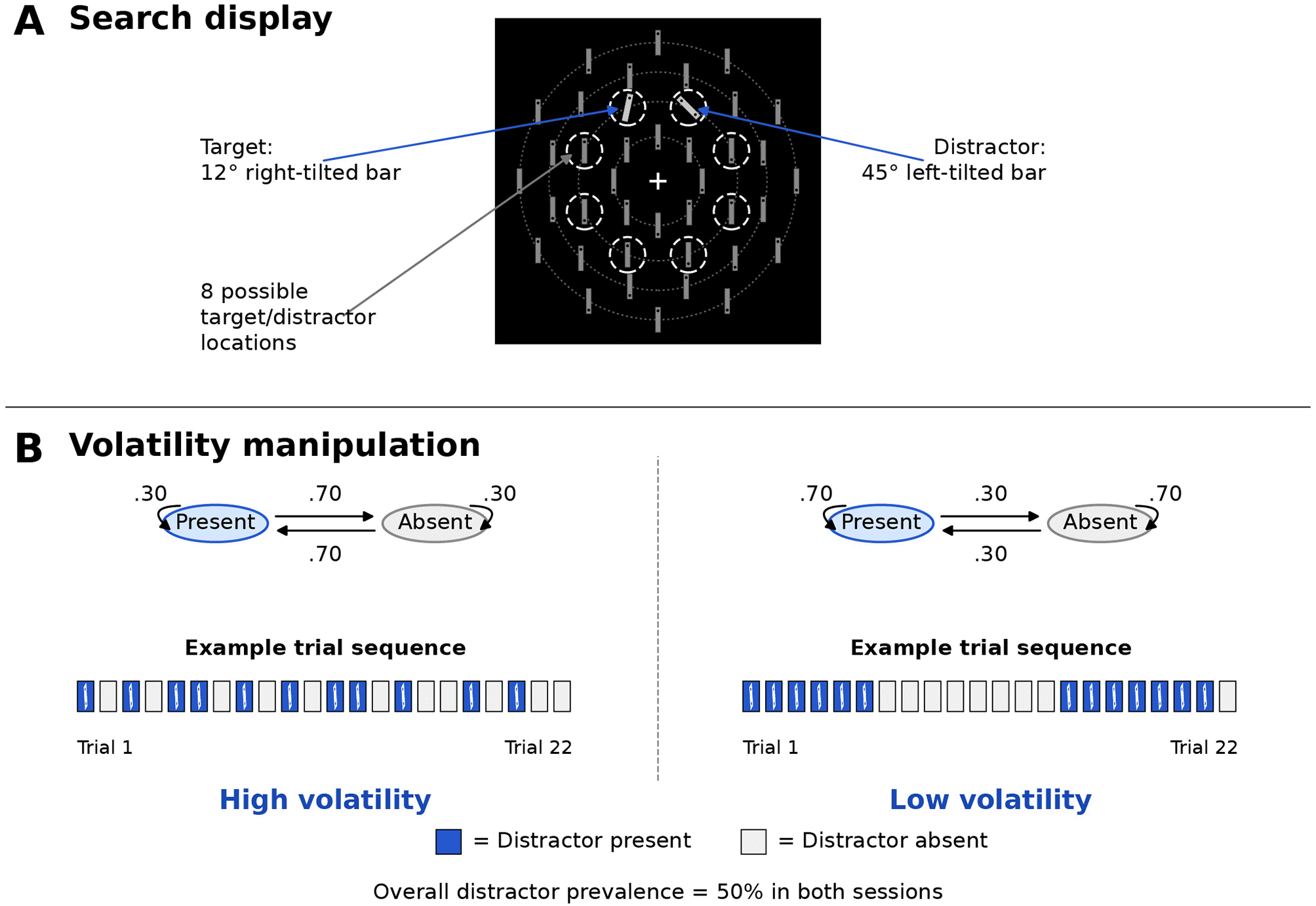
The task and sequence manipulation. Participants reported the target’s notch position while ignoring a more tilted bar. Distractor presence switched more often in the high-volatility session. Figure 1 from Qiu et al. (2026), PLOS Computational Biology, CC BY 4.0.
Recent history explains the gaze-capture difference
Across all distractor-present trials, the first eye movement landed on the distractor more often under high volatility: about 41%, compared with 33% under low volatility. But rapidly changing sequences also offered fewer opportunities to learn from consecutive repetitions of the distractor at the same location.
When we compared trials at the same repetition position, there was no detectable volatility difference in initial gaze capture. Repeated distractor locations attracted the eyes less often in both sessions, with no detectable difference in the repetition-learning slope. The pooled capture difference was therefore consistent with the different mixtures of repetition histories; the matched comparison did not establish exact equivalence between the two environments.
The later stages told a different story. On trials without a distractor, the measures shifted together toward more fixations, longer final inspection of the target, slower responses and fewer errors under high volatility, without a detectable delay in first reaching the target. None of these individual measures survived correction for multiple comparisons. Support for the caution account came from a pre-specified test combining the measures in the predicted direction.
Computational model comparison favoured allowing both evidence-accumulation and response-criterion changes. Separate, simpler model projections described slower accumulation and a higher criterion under high volatility. The full model could not uniquely separate these components, so they are descriptive interpretations rather than identified mechanisms.
With 21 observers, small effects on gaze capture remain possible, and eye movements cannot rule out changes in attention that occur without moving the eyes. What the study does show is why search needs to be examined in stages: a changing environment can alter how carefully people verify and respond, while an apparent difference in initial distraction can arise from the recent histories built into the experiment itself.
Read the paper
Qiu, N., Allenmark, F., Chen, S., Müller, H. J., & Shi, Z. (2026). Environmental volatility is associated with adaptive caution in visual search. PLOS Computational Biology, 22(10), e1014310. https://doi.org/10.1371/journal.pcbi.1014310.