 MSense
 You make a cup of tea and decide to let it steep for “about three minutes”, no timer. Whether those three minutes come out a little long or a little short depends partly on what you have just been timing. Our sense of how long something lasts is not measured from scratch each time. Without noticing, we lean on the durations we have just lived through.
In the lab this is easy to see. Ask someone to reproduce a short interval, say by holding a button for as long as a light was on, and their answer will depend a little on the interval they reproduced just before. After a long one, they hold a bit longer; after a short one, a bit shorter. This pull toward the recent past is called serial dependence, and it shows up for almost everything we judge, from the orientation of a line to the expression on a face.
For visual features such as orientation, the previous trial leaves traces at several levels of processing. Early visual cortex shows history effects, but the attractive pull itself seems to arise at later, higher-order stages, including prefrontal cortex. For time, much less is known. One possibility was that the last duration stays close to the senses: if you watch a moving pattern and judge how long it lasted, the previous duration might linger in the visual areas that processed the pattern.
The task
One problem with looking for this trace is that every trial carries more than one leftover. Besides the memory of the last stimulus, there is also the effort of getting ready for the next task. To separate the two, we had participants in the MRI scanner watch a cloud of moving dots. Only after the dots had disappeared did a letter tell them what to report: T meant reproducing how long the motion lasted by holding a button, and D meant reproducing the direction of motion by rotating a line.
Since the question came only at the end, participants had to keep both the duration and the direction of every stimulus in mind. The question sometimes repeated from one trial to the next and sometimes switched. That gave us two features of one and the same stimulus to compare, and a way to tell the memory of the last trial apart from the cost of switching tasks.
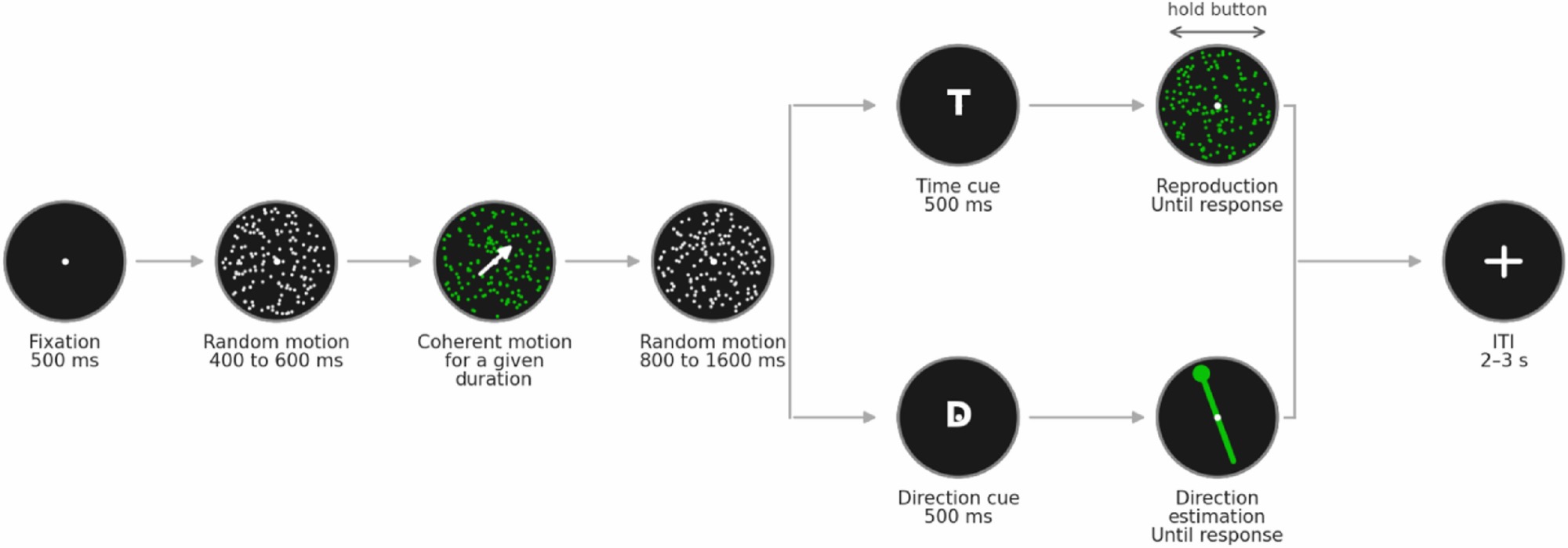
Figure 1. Task design. A coherent motion stimulus of a given duration appeared between random-motion masks. A retro-cue then told participants to reproduce either the duration (T, by holding a button) or the motion direction (D, by rotating a line).
Duration and direction behave differently
The behavioral data already showed that the two features follow different rules. Reproduced durations were clearly pulled toward the previous duration, and about four times more strongly when the previous trial had also asked about time than when it had asked about direction. Direction showed only a small bias, and its sign depended on the previous task: a slight pull toward the previous direction after a direction trial, and a slight push away from it after a time trial.
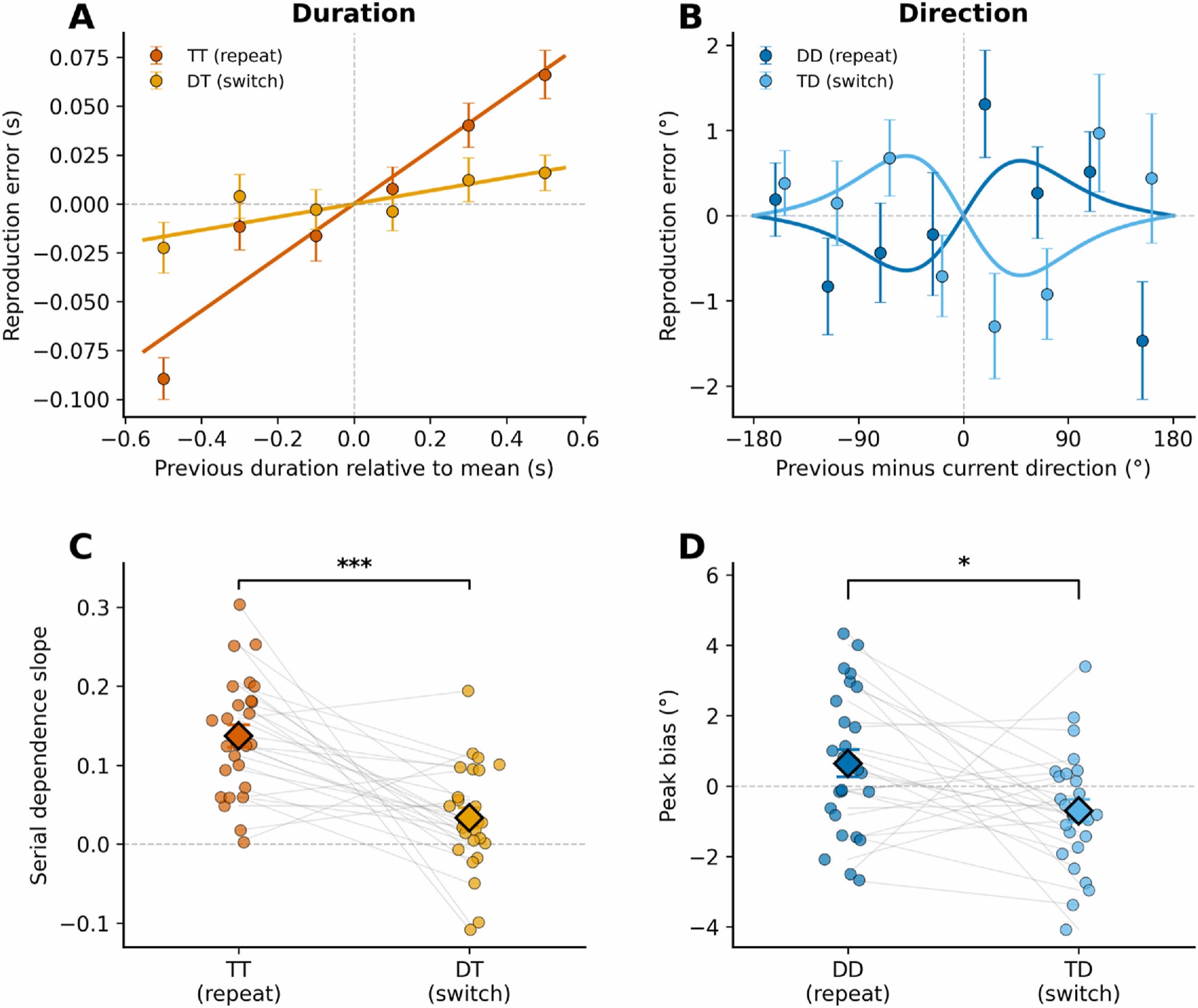
Figure 2. Behavioral serial dependence. (A) Duration reproduction error as a function of the previous duration, for task-repeat (TT) and task-switch (DT) trials. (B) Direction reproduction error as a function of the previous-minus-current direction, for DD and TD trials. (C) Duration serial dependence slopes were much larger on repeat than switch trials. (D) Peak direction bias reversed sign between repeat and switch trials.
The previous duration shows up in the putamen
In the brain, the previous duration did not show up in visual cortex. When the next question appeared, the only region whose activity tracked the previous duration across the whole brain was the putamen on both sides, a part of the dorsal striatum that has long been linked to timing. The longer the previous interval, the weaker the putamen response. We also checked whether this was just a trace of the last button press: the effect remained after accounting for both the current and the previous responses.
For the previous direction, we found no comparable signal anywhere.
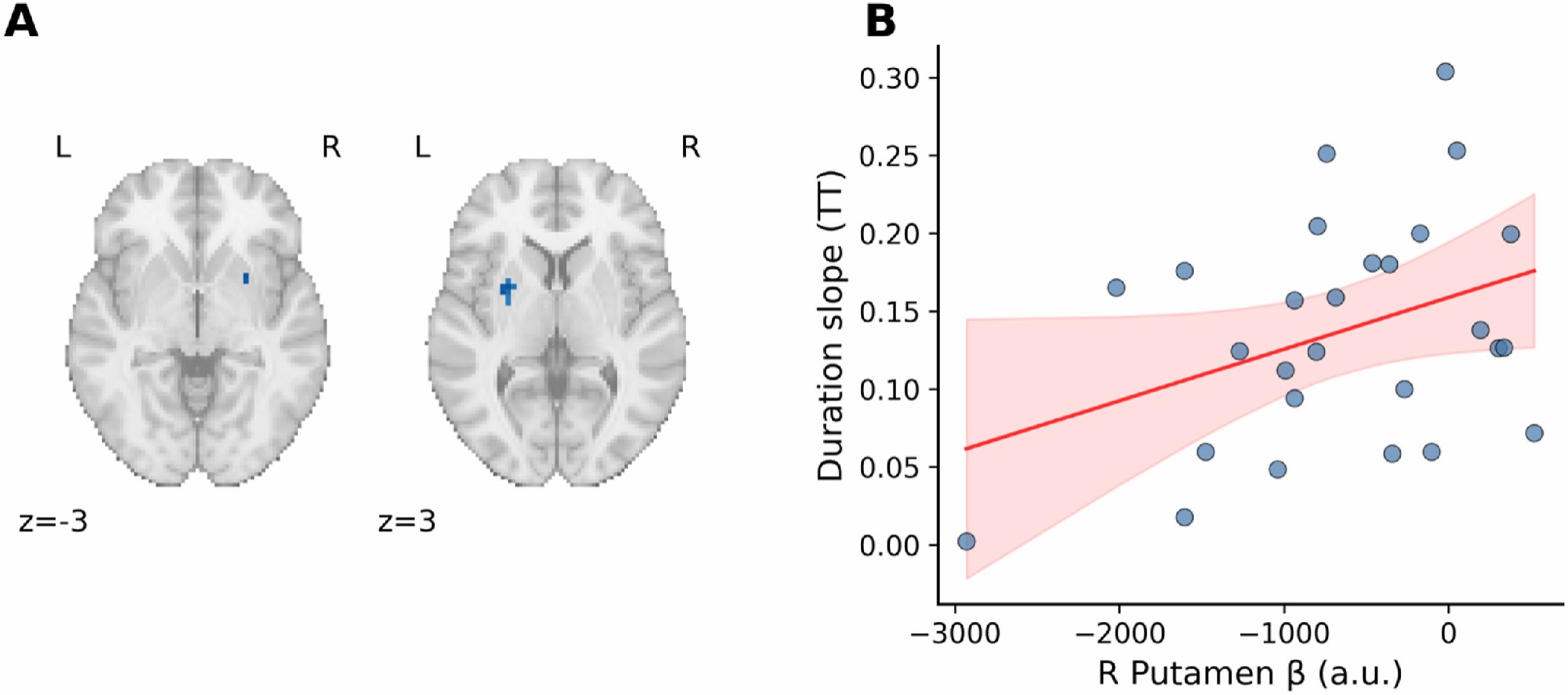
Figure 3. The prior-duration signal in the putamen. (A) Putamen clusters where activity was modulated by the preceding duration. (B) Individual right-putamen estimates plotted against each participant’s duration serial dependence on task-repeat trials.
Switching tasks uses other regions
Switching from the direction task to the time task engaged the inferior frontal junction and the dorsolateral prefrontal cortex, frontal regions involved in setting up a new task. Neither of them carried information about the previous duration. Keeping the last interval and preparing for the next task took place in different parts of the brain.
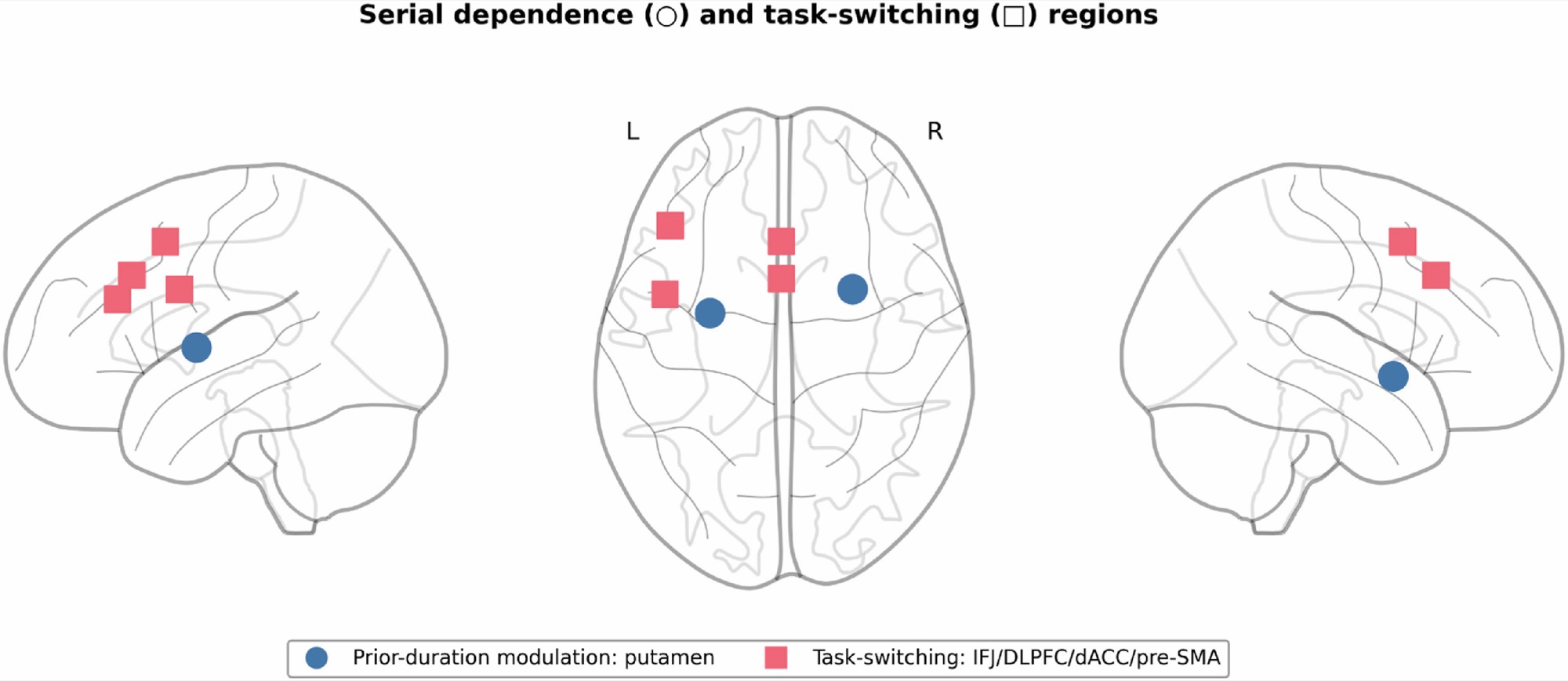
Figure 4. Anatomical summary. Prior-duration modulation localized to the putamen (circles), separate from the frontoparietal regions engaged by task switching (squares: IFJ, DLPFC, dACC, pre-SMA).
What this means
Serial dependence is often discussed as if it were one general mechanism. Our results suggest otherwise. Even for a single stimulus, the brain handles the recent history of its duration and its direction differently, and for time, information about the last interval shows up in the striatum rather than in visual cortex.
This work, led by Dr. Si Cheng, has been published in NeuroImage: Reports (2026):
Cheng, S., Chen, S., Wu, J., Qu, C., & Shi, Z. (2026). Neural substrates of duration serial dependence: Putamen suppression of the prior duration trace. NeuroImage: Reports, 6(4), 100414. https://doi.org/10.1016/j.ynirp.2026.100414