Posts

Research
Electrophysiological signatures of temporal context
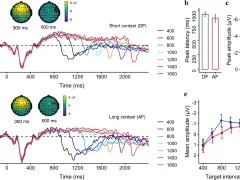
Bisection experiments with EEG by Baykan and colleagues show that stimulus spacing and sample frequency pull duration judgments toward the context mean, altering the CNV rate and the LPCt amplitude …
Lab News
Cemre and Nan, Congratulation!
Cemre Baykan and Nan Qiu have passed their Ph.D. defenses summa cum laude, Cemre on behavioral and neurophysiological correlates of interval timing, Nan on the neural and behavioral basis of …
Research
Little engagement of attention by cross-dimension distractors
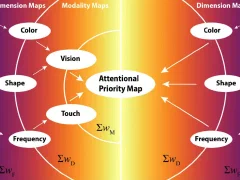
Tsai et al. varied salient distractors while holding the target fixed: only a distractor sharing the target dimension interfered and reduced the N2pc; cross-dimensional and cross-modal distractors …
Research
Influences of temporal order in temporal reproduction
Baykan et al. had people tap out accelerating, decelerating or random four-interval sequences: the first interval pulled the mean reproduction, while volatility and the last interval drove the central …
Research
Asymmetric learning of dynamic spatial regularities
Yu and colleagues shifted the target or a distractor one step clockwise or counterclockwise across trials and found robust learning of the predictable target location but little proactive suppression …
Research
Long-term vs. short-term distractor location effect
Using lateralized ERPs in the additional-singleton paradigm, Qiu and colleagues tied statistically learnt distractor-location suppression to an early N2pc and inter-trial suppression to an enhanced …
Research
Hierarchy of intra- and cross-modal redundancy gains
In visuo-tactile search, Nasemann and colleagues found the PCN EEG component sensitive to redundant features across modalities. Its amplitude and timing explained about 25% of RT variance, supporting …
Research
Statistical context learning in tactile search
Chen et al. found that adding a redundant visual context to tactile search brings no extra contextual-cueing benefit, suggesting that the task-critical modality sets the reference frame for context …
Research
Context in temporal decision making
Baykan and Shi comment on Ofir and Landau’s finding that the offset P3b tracks the temporal bisection point, noting that this point is itself set by context such as stimulus spacing and ensemble …
Research
Beyond Scalar timing theory
Shi and colleagues propose a multifrequency oscillatory model that gives timing the computational accessibility most scalar-property models ignore and accounts for both retrospective and prospective …
Lab News
Dr. Siyi Chen got a new DFG funding
Siyi Chen and Zhuanghua Shi have won a three-year DFG grant, with a postdoc position dedicated to Siyi, to study how uncertainty shapes context guidance and suppression in context learning.
Research
Oscillation models of reward-related timing
Bin Yin and colleagues review striatal beat-frequency and coupled oscillation models of interval timing and propose a unified account linking corticostriatal and corticocerebellar circuits, dedicated …
Research
Perceptual biases and Individual beliefs
A two-state Bayesian model from Glasauer and Shi explains why people differ in central tendency and sequential biases: implicit beliefs about temporal continuity set how much each person leans on …
Research
Distractor suppression in the early visual cortex
Combining probability-cueing visual search with fMRI, Bei Zhang and colleagues linked reduced interference from frequent-location distractors to suppressed distractor-evoked activity in early visual …
Research
Does distractor frequency in one region affect distractor suppression in another region?
Allenmark and colleagues varied distractor prevalence across display regions and found that interference in one region was unaffected by distractor frequency in the other, pointing to purely local …
Research
Contextual cueing in co-active visual search: Joint action allows acquisition of task-irrelevant context 
Searching side by side with a partner lets people learn repeated display layouts relevant only to the partner, a context solo searchers fail to acquire. Published in Attention, Perception & …
Research
Cross-modal contextual memory guides selective attention in visual-search tasks
ERPs show that repeated tactile distractor layouts speed visual search as much as repeated visual ones, and both boost the same attentional-selection (PCN) and target-analysis (CDA) stages. Published …
Research
Inter-trial effects in priming of pop-out: Comparison of computational updating models
Evidence-accumulation models with competing updating rules, fitted to priming-of-pop-out data, trace color and position priming to a shared weight resource setting accumulation rate, and response …
Curious Minds
The 150-Year-Old Mistake That Taught Us How the Brain Keeps Time
Karl von Vierordt thought he had found a law of time perception. Glasauer and Shi show his random interval order created the distortion, which nearly vanishes when durations drift as a random walk.
Research
V5/MT+ modulates spatio-temporal integration differently across and within hemifields: causal evidence from TMS
Single-pulse TMS over left V5/MT+ tipped Ternus displays toward element motion across hemifields but toward group motion within a hemifield, giving causal evidence for its role in spatio-temporal …
Research
Personality Traits, Loneliness, and Affect Among Boxers
Among 231 boxers, conscientiousness, extraversion and agreeableness went with more positive and less negative affect, neuroticism the reverse, and loneliness mediated the link. Published in Frontiers …
Research
The origin of Vierordt’s law: The experimental protocol matters
Simulating Vierordt (1868) with iterative Bayesian updating and testing random versus random-walk duration sequences, Glasauer and Shi show that the classic central tendency stems from an unnatural …
Research
Perceiving Tempo in Incongruent Audiovisual Presentations of Human Motion: Evidence for a Visual Driving Effect
When point-light dancers and rhythmic beats disagree on tempo, participants follow the dancers: a bisection task showed visual tempo driving overall judgements up for fast and down for slow rhythms.
Research
Variation in the “coefficient of variation”: Rethinking the violation of the scalar property in time-duration judgments
Duration reproductions and their coefficient of variation both shift with temporal context, and a two-stage Bayesian model captures these shifts without abandoning a constant Weber fraction, so CV …