Posts

Research
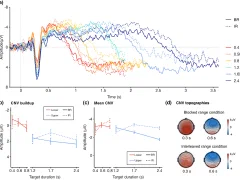
Blocked versus interleaved: How range contexts modulate time perception and its EEG signatures
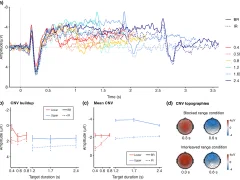
Dr. Baykan and colleagues report in Psychophysiology that blocking short and long intervals, instead of interleaving them, sharpens time estimates and produces faster, stronger CNV buildup plus a …
Lab News
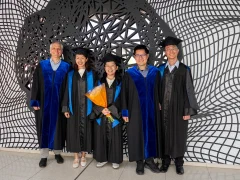
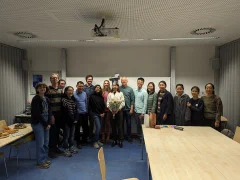
GSN Graduation Day, Congratulations!
Dr. Nan Yan, Dr. Lingyue Chen, Dr. Shao-Yang Tsai and Ms. Yun Wai Foo celebrated their graduation at GSN Graduation Day, and all four have already secured jobs, postdoctoral or doctoral positions.
Lab News
Talk on Understanding Time at Mainz University
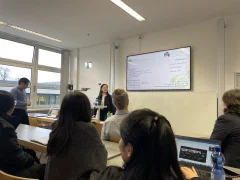
Hosted by Prof. Daniel Oberfeld-Twistel at Mainz University on June 12, Dr. Z. Shi explained how context and Bayesian priors bias time judgments, with CNV, LPCt and hippocampal findings from EEG and …
Lab News
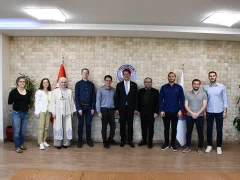
EU Behavioral Science Lab Training at Çanakkale Teknopark with LMU and COMU Collaboration
Dr. Fredrik Allenmark taught PsychoPy and Prof. Dr. Zhuanghua Shi covered AI tools for behavioral research at Çanakkale Teknopark, where COMU, Teknopark and LMU agreed to establish a Behavioral …
Research
Impact of Contextual Guidance and Suppression on Visual Search Efficiency
Siyi Chen’s visual search study in Psychonomic Bulletin & Review shows that learned context-target associations speed search strongly but break down when reversed, whereas context …
Research
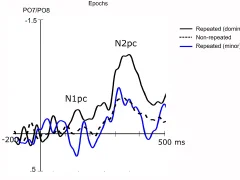
Selective contextual association
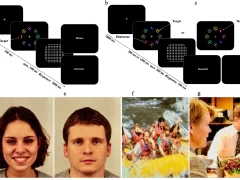
EEG recordings by Artyom Zinchenko and Xuelian Zang show that repeated distractor layouts speed search only for one dominant target, marked by early N1pc and N2pc, while a second target evokes a later …
Lab News
Talk on Visual distractor suppression at Oldenburg University
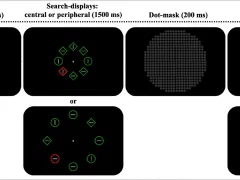
At Oldenburg University, hosted by Prof. Hans Colonius, Dr. Zhuanghua Shi presented EEG and fMRI evidence that same-dimension distractors slow search and dampen the N2pc, while cross-dimension color …
Research
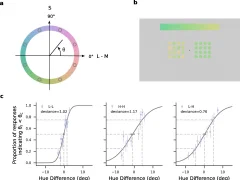
Understanding Color Perception: How Natural Daylight Cues Influence Hue Discrimination
Hue discrimination is most accurate and least biased along the color axis matching natural daylight; a Bayesian observer model with a prior favoring blue tones explains the pattern, published in …
Research
How range contexts modulate time perception and its EEG signatures
Presenting short and long intervals in separate blocks, rather than mixed, yields more accurate time estimates and a faster, stronger CNV buildup, as an EEG study led by Dr. Cemre Baykan shows.
Curious Minds
New insights into Vierordt’s law: A talk by Prof. John Wearden
Prof. John Wearden came to Munich to revisit Vierordt’s Law, weighing internal-clock and contextual accounts of why we overestimate short intervals and underestimate long ones, and argued that …
Research
Influence of Temporal and Probabilistic Expectation on Subjective Time of Emotion Stimulus
Karaaslan and Shi report in the Quarterly Journal of Experimental Psychology that images arriving earlier than expected feel briefer, rare images feel longer, and negative images outlast neutral ones, …
Research
Influence of Temporal and Probabilistic Expectation on Subjective Time of Emotion Stimulus
Karaaslan and Shi found that emotional images arriving earlier than expected felt shorter, rarer ones felt longer, and negative images seemed to last longer than neutral ones, with expectancy and …
Lab News
Yannan Su, Congratulations!
Yannan Su passed her PhD defense on 21 March 2024 with a thesis on contextual biases in color and orientation perception, two studies from which are already published.
Lab News
Workshop on “Predictive Attention” Yields Insightful Discussions
Dr. Siyi Chen of LMU CAS gathered speakers from Lancaster, Oxford, Nijmegen, Peking, Columbia and Amsterdam for a two-day workshop, 18-19 March 2024, debating how our minds anticipate and react to the …
Lab News
Congratulations, Shao-Yang Tsai!
Shao-Yang Tsai passed his PhD defense on 11th March 2024 with a thesis on the neural correlates of distractor handling in cross-modal search, capping years of dedicated research.
Lab News
Congratulations, Lingyue Chen!
Lingyue Chen defended her Ph.D. thesis on 6th March 2024, From Action to Time, examining how attention and sensorimotor integration shape time perception.
Research
High demand redirects increased anxiety to uphold goal-directed attention
Experimentally raised state anxiety left dual-target search performance unchanged: high task demand and working memory load appear to redirect anxiety and keep attention goal-directed rather than …
Research
Influence of Action on Sequential Dependence
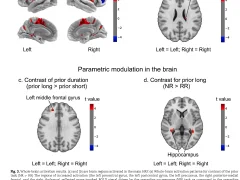
An fMRI study in Cerebral Cortex shows that prior durations bias current time judgments only after active reproduction, not passive viewing, with hippocampal activity shielding encoded durations from …
Curious Minds
TEDxTUM talk on “Hidden time cues shape our decisions”
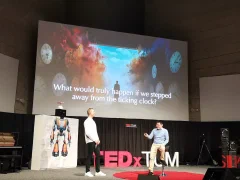
Zhuanghua Shi took the TEDxTUM stage at Simple Complexity on Nov. 4th to show how hidden time cues quietly steer everyday choices and how we can learn to spot and master them.
Curious Minds
Eye movement: innovation in visual perception training
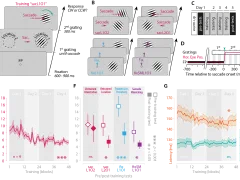
Training vision while the eyes move lets perceptual learning spread beyond the trained spot to untrained parts of the visual field, LMU Newsroom reports on the PNAS study by Grzeczkowski, Shi, Rolfs …
Curious Minds
Feng Meng, can the ability to see a flea as large as a wheel be transferred?
Lukasz Grzeczkowski shows in PNAS that perceptual learning transfers to a new location when the eyes saccade there, though not to a new feature, told through the Chinese myth of archer Feng Meng.
Research
Reference induced biases in late visual processing
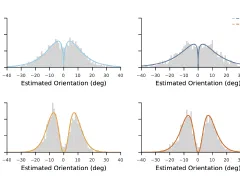
Yannan Su et al. showed that an orientation reference presented after an ensemble stimulus still repels reproduced orientations, especially in a dual task, and an encoding-decoding model with …
Research
Valence color preference and association
Stanković and colleagues found no overall effect of emotion-color association on task performance, but each participant’s own valence preference for red or green shaped how a task-irrelevant …
Lab News
Academic exchanges resume after three years of pandemic halt
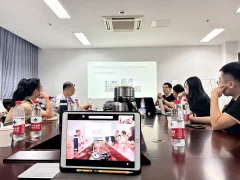
Zhuanghua Shi gave talks at Zhejiang University, Hangzhou Normal University and Beijing Sport University, and the long-delayed Sino-German symposium on multisensory processing finally ran in Beijing …