 MSense
A higher fMRI signal just before a search display was associated with slower responses in one group and faster responses in another. The two groups looked for the same target. What differed was the kind of distraction they had encountered most often and where it tended to appear. Siyi Chen and colleagues report the finding in a new open-access paper in Cortex.
What people learned to ignore
The team reanalysed functional MRI (fMRI) recordings from 34 adults. Participants searched among upright bars for a slightly tilted target and reported whether its notch was at the top or bottom. A distractor could be a more strongly tilted bar or an upright red bar. The more strongly tilted bar slowed search much more than the red one: it stood out for the same reason as the target.
For half the participants, the tilted distractor was more common and usually appeared in one part of the display. For the other half, the red distractor followed that pattern. Participants were less slowed by tilted distractors at their usual locations than at rare ones. The corresponding location effect for red distractors was smaller and less clear.
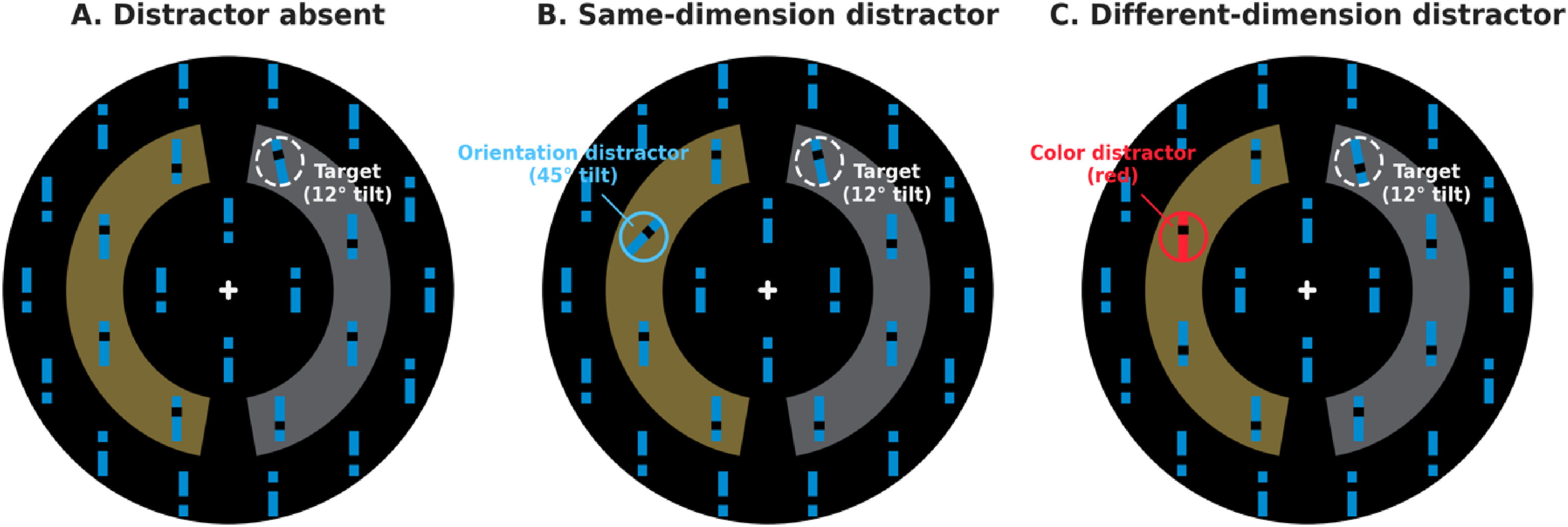
The search task. Circles, shading and labels are explanatory and were not shown to participants. Figure 1 from Chen et al. (2027), Cortex, CC BY 4.0. The card thumbnail uses a resized version of the same figure.
A similar brain response, opposite links to search speed
For each trial, the team averaged the fMRI signal across grey matter in the two seconds before the display appeared. A higher value on this measure, called the global signal, was linked to slower responses in the group that usually encountered tilted distractors and faster responses in the group that usually encountered red distractors. A measure from one set of brain regions, the default mode network, showed a similar pattern. Yet across both groups, a higher global signal generally preceded weaker fMRI responses to the display in several attention and visual regions, even though its link to response speed went in opposite directions.
The clearest difference was between the two groups. The study did not reliably show that the link changed with the type or location of the distractor on an individual trial. And because the distractor with a predictable location was also the one people saw more often, the study cannot tell whether learning where to expect it, encountering it more often, or both explain the group difference. A follow-up could separate those possibilities by varying location predictability while keeping the mix of distractors fixed.
Read the paper
Chen, S., Allenmark, F., Yu, H., Müller, H. J., & Shi, Z. (2027). Pre-stimulus cortical state predicts behavioral performance differently across distractor-learning contexts. Cortex, 206, 318–336. Read the open-access article. Published online in November 2026 and assigned to the January 2027 volume.